It's All Right. You Have Surely Grown
September is drawing to an end. On the western edge of Nara City, among the low hills known as Gojo-yama, stand the kilns of Akahada ware. Six Akahada kilns remain today. Counted among the Seven Kilns of Enshu, said to have been favored by the tea master Kobori Enshu, Akahada ware is known for its soft, milky-white surface tinged with red, and for Nara-e, simple pictures painted with an unpretentious brush.
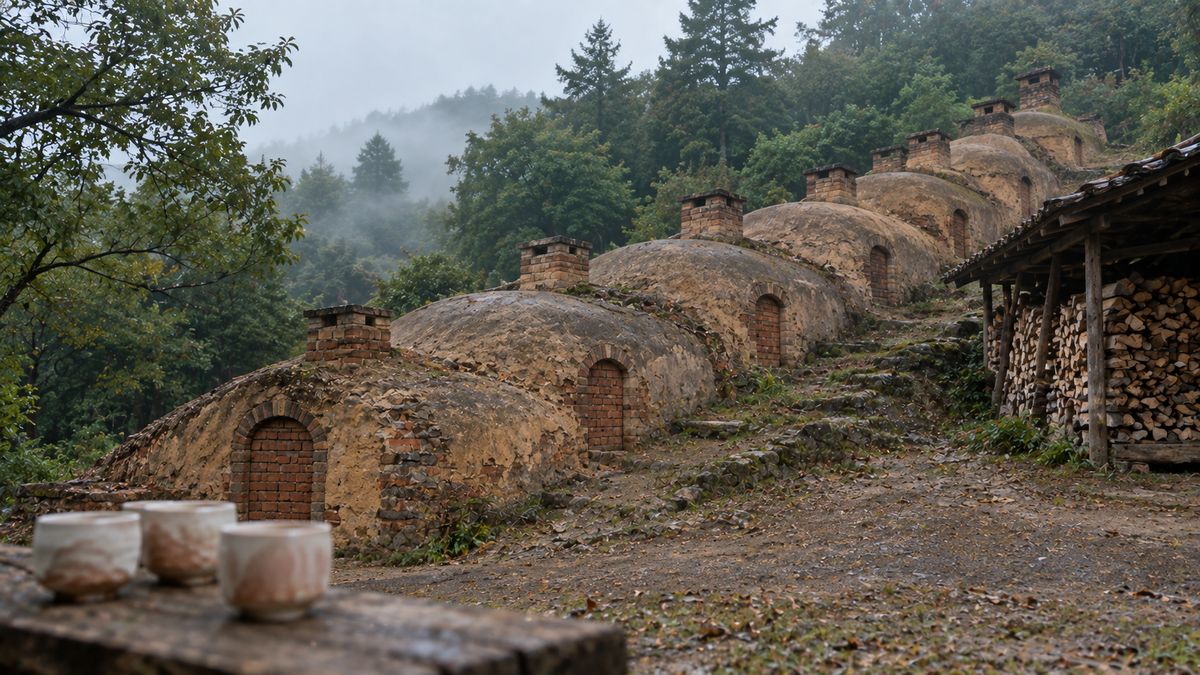
At one of them, the Akahada-yama Moto-gama kiln, a large brick climbing kiln is built into the slope on the north side of the grounds. Built at the end of the Edo period, it is about eighteen meters deep, 5.4 meters wide and six meters high. At the bottom are two chambers for the fire, and above them eight firing chambers rise one after another up the slope, with a flue at the very top; the outside is plastered with earth. The history of this kiln goes back to the late Edo period, when Yanagisawa Gyozan, lord of the Koriyama domain, brought potters from Kyoto to revive the craft. The great kiln was registered as a national Tangible Cultural Property in 2007, and after repairs that began in 2015, fire was lit in it again in February 2019, for the first time in about fifty years.
In a climbing kiln, the pieces are packed into the chambers, the openings are sealed, and a fire of firewood is built up from below. The flames creep up the slope from chamber to chamber, threading their way between the pieces, and escape through the flue at the top. The fire is fed for days on end, and when at last the stoking holes are shut, the kiln begins to cool, slowly. Until it has cooled completely, there is no way to see from outside how the pieces within have turned out.
After you have worked at something for a certain period of time, you may find yourself thinking, 'Was this really all right? Could I not have done more?'
This is especially so while you are waiting for the results of what you have done.
But if you have done all that you could do, you can simply move on to what comes next; and if where you fell short is already clear, you can simply begin working on it.
In short, all you need is not to keep clinging to what is already done.
There is nothing you can do about what has already left your hands, or about the result itself.
It's all right. Compared with before you took it on, you have surely grown.
And how you take the result that comes out is also something you can decide.
Once the kiln has cooled, the sealed openings are taken down, and the pieces are carried out one by one. This is called kama-dashi, the unloading of the kiln. The heat differs from place to place inside the kiln, and depending on the path of the flames and how the ash settles, pieces coated with the same glaze do not always come out the same color. In the world of Japanese pottery, the unexpected changes brought about by the fire are called keshiki, or 'scenery.' Seeing flowing glaze as clouds, and a crack as the ridge of a mountain, tea masters have long treasured them. Before long, the empty kiln will be packed with new pieces once again. At dusk at the end of September, the old kiln on the hill quietly waits for its next fire.