Success in Life Is Yours to Decide
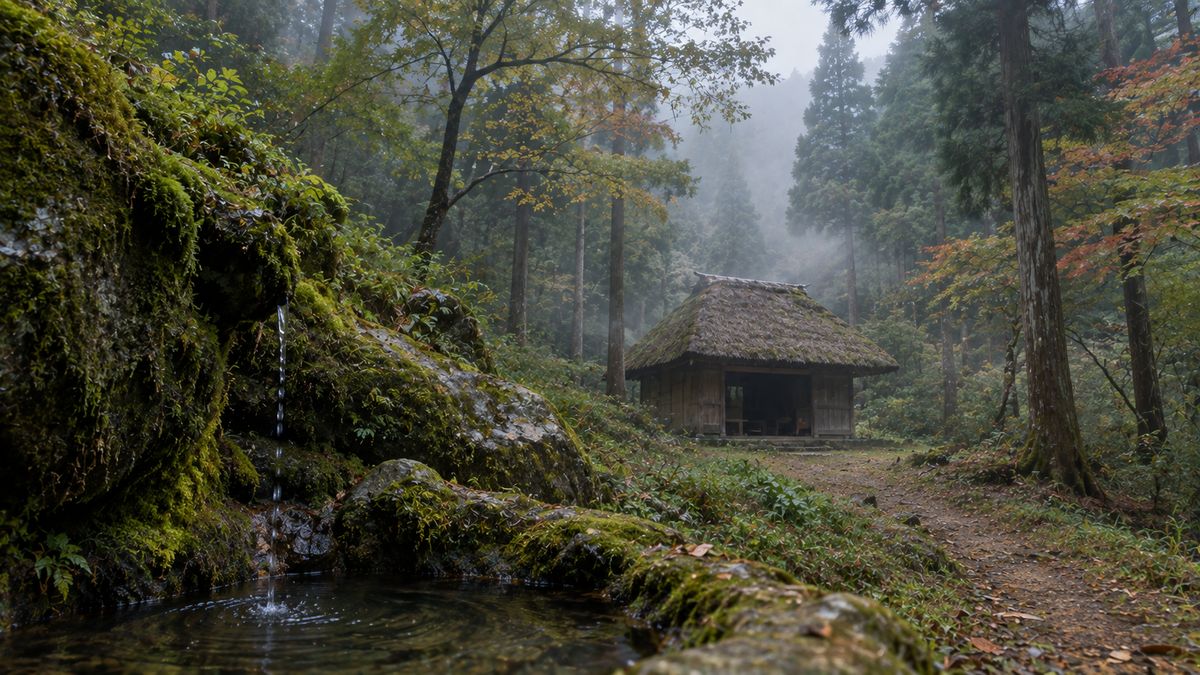
September is drawing to an end. Deep in Oku-senbon, the innermost part of Mount Yoshino, a narrow mountain path runs from Kimpu Shrine through groves of cedar. After a walk of about a third of an hour, a small hermitage comes into view, standing quietly on a patch of flat ground in a little valley. This is Saigyo-an. Inside the tiny building sits a wooden statue of the monk-poet Saigyo. In spring the mountain cherries, and as autumn deepens the maples, quietly color this valley.
Saigyo was born Sato Norikiyo in 1118, into a warrior family whose men had served in the palace guards for generations. He served the retired Emperor Toba as one of the Hokumen no Bushi, the warriors who guarded the retired emperor's palace, and he was a young warrior known also for his gift for waka poetry. Taira no Kiyomori, born in the same year, was serving among the same guards at around the same time.
In 1140, at the age of twenty-three, Norikiyo suddenly renounced the world and became a monk. Even now, no one knows for certain why. Some say it was the death of a dear friend; others, a love that could never be. In time Saigyo came to Yoshino, and he is said to have spent about three years in this hermitage in Oku-senbon. Beside the hermitage, clear water still springs from between the rocks. It is called Koke-shimizu, the Moss Spring, after a poem said to have been composed by Saigyo: 'Drip by drip it falls, the mossy spring between the rocks; so simple is my dwelling, I need not draw it dry.'
Of course, everyone goes through life wanting to succeed.
But what, in the first place, is 'success' in life?
Without realizing it, are you not being swayed by a concept of 'success' borrowed from somewhere else?
It is not something that should be defined by society or by other people; it is something you should find for yourself.
Whatever anyone may say, it is for you to decide.
In it, there is no good or bad, no better or worse.
It is, completely, your own freedom.
Kiyomori, born in the same year, went on to rise all the way to Grand Minister of State, the first warrior ever to do so. Saigyo spent his whole life traveling and composing poems: to Mutsu in the far north, to Shikoku, and for many years he also made his home on Mount Koya. 'Let me die in spring, beneath the blossoms, around the full moon of the second month.' On the sixteenth day of the second month of 1190, Saigyo came to the end of his seventy-three years at Hirokawa-dera temple in Kawachi. It was the day after the full moon of the second month, the day on which the Buddha is said to have entered nirvana. Fujiwara no Teika and the priest Jien were deeply moved that his end had come just as his poem had wished. At the end of September, in the hermitage at Oku-senbon, the small statue of Saigyo sits quietly again today.