Give Advice Without Seeking Anything in Return
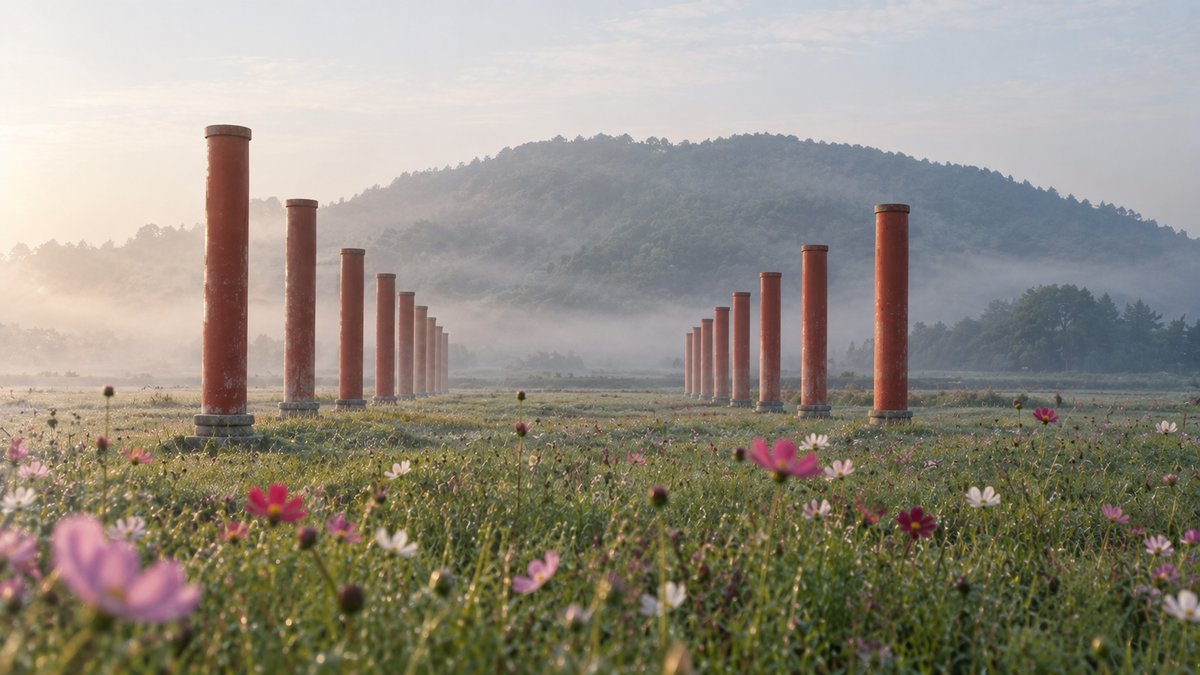
As September draws to an end, at the Fujiwara Palace Site in Kashihara, a flower garden stretches south of the site of the Imperial Audience Hall, where fields of cosmos await their season in October. Once October comes, some 2.4 million cosmos are said to bloom there, across about twenty-four thousand square meters. The palace site is ringed by the Three Mountains of Yamato: Mount Kagu to the east, Mount Unebi to the west, and Mount Miminashi to the north. Here and there in the grass stand lines of vermilion pillars, recreating the pillars of the gate that once opened into the inner court of the audience hall. It was Empress Jito who moved the capital to this place. From 694 to 710, three sovereigns governed from here.
This happened while Empress Jito was still at the Asuka Kiyomihara Palace. On the eleventh day of the second month of 692, she told her officials that she would travel to Ise on the third day of the third month, and that they should prepare their clothing and other things for the journey. On the nineteenth day, Miwa no Takechimaro, a Middle Counselor, submitted a written protest. A royal journey in the season of farm work, he warned, would stand in the way of the farmers' labor. The Miwa clan served the god of Mount Miwa at Omiwa Shrine, and twenty years earlier, in the Jinshin War of 672, Takechimaro had fought on the side of Emperor Tenmu.
On the third day of the third month, officials were appointed to guard the capital while the empress was away. Takechimaro then took off his court cap, the mark of his rank, lifted it up before the court, and pleaded once more: 'In the season of farming, the imperial carriage must not yet be set in motion.' Three days later, on the sixth day of the third month, the empress did not heed his counsel, and set out for Ise.
Even when you give someone advice, it is not always the case that the person will listen to that advice and put it into practice.
But that is no reason to be indignant or disheartened.
For it is not you yourself who has been rejected.
Each person makes their choices in their own freedom and on their own responsibility.
Whether to listen to your advice, and whether to put it into practice, is also for the other person to decide.
This is so even when you gave the advice because the other person asked for it.
What matters most is not to seek anything in return.
During that journey, on the seventeenth day of the third month, the empress granted court ranks to the chieftains of Iga, Ise and Shima and of the shrine districts she had passed through, and freed them from that year's taxes and labor duties. The mounted guards who attended her, the bearers who carried the loads, and the workers who built her temporary palaces were freed from that year's duties as well. She returned to the capital on the twentieth day. The Nihon Shoki says nothing more of Takechimaro after this. His name next appears in the written histories ten years later, in the first month of 702, when he was appointed governor of Nagato Province. As he was about to leave for that distant land, a banquet was held beside the river at Miwa, and he composed a poem: 'As long as the Hatsuse River, which the god of Mimoro wears as a sash, keeps its flowing course, how could I ever forget?' From now into October, the cosmos of the Fujiwara Palace Site will come into full bloom across the grass, ringed by the Three Mountains of Yamato.