From Time to Time, Ask Yourself
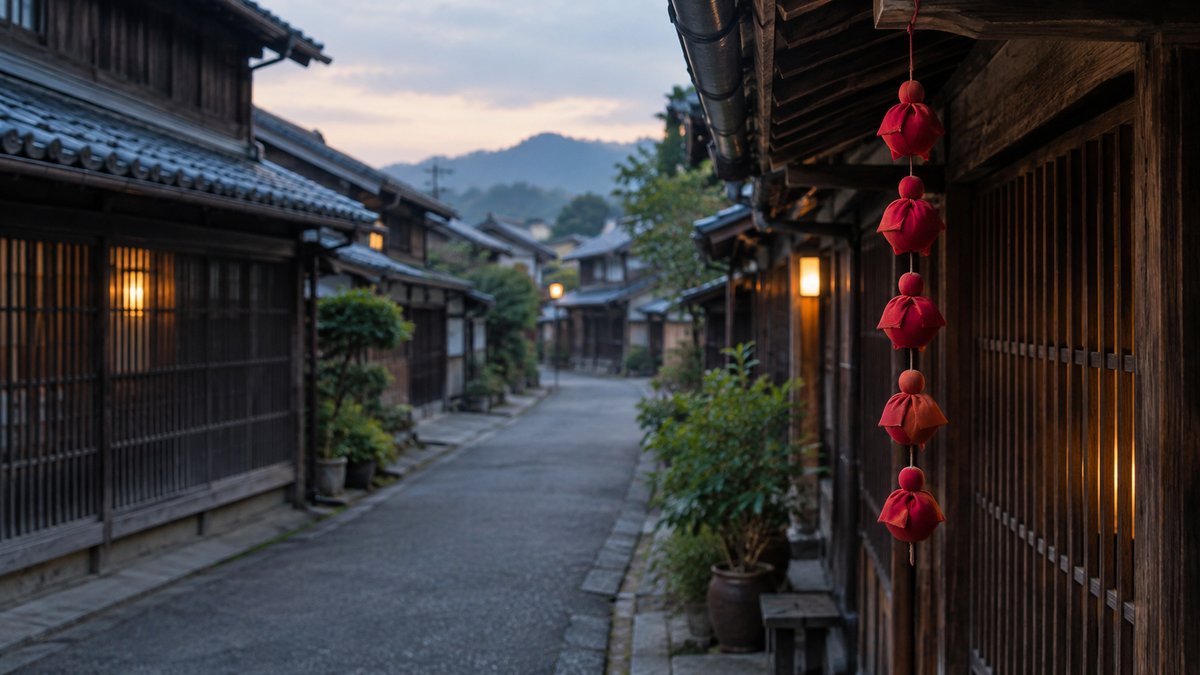
Today is the last day of September. Walking the narrow lanes of Naramachi, you may notice small red things hanging from the eaves of old townhouses with latticed fronts. They are migawari-zaru, 'substitute monkeys,' cloth charms that the people of the town call Koshin-san. Each one is made by folding the four corners of a small red cushion and tying them together, with a round head attached, and the shape is said to show a monkey with its hands and feet bound, its head lowered and its body curled. As charms that take upon themselves any misfortune trying to enter a home, in the past one was hung under the eaves for each member of the family.
The heart of this faith in Koshin-san is a small Koshin-do hall in Nishi-shinya-cho. This area is said to have once been part of the grounds of Gango-ji temple, and the hall enshrines Shomen Kongo, a blue-faced guardian deity. In the Edo period, when a meeting hall was set up in the neighborhood, Koshin faith spread among the townspeople.
According to Koshin belief, three worms called sanshi dwell inside the human body. On the night of Koshin, which comes around once every sixty days, they slip out while a person sleeps and go to report that person's everyday deeds to the Celestial Emperor, or so it has long been told. And so, on Koshin nights, people of old gathered without sleeping and passed the night in conversation until dawn. This was called Koshin-machi, the Koshin vigil. This year, the next Koshin day comes around on October 13.
From time to time, try asking yourself.
Without realizing it, are you not causing trouble for those around you?
Are you not spreading your arrogance around?
Are you not asserting yourself far too grandly?
These actions mean that you are loudly broadcasting your own weakness to those around you.
And hidden behind these actions is a way of presuming on those around you, and on others.
In other words, it is the presumption that whatever attitude you take, you ought to be forgiven.
But a person who understands that they are 'no one in particular,' who keeps themselves filled, and who can be kind to others, will not behave that way.
It comes down to who you want to become.
At the Naramachi Shiryokan, a small museum a short walk north of the hall, substitute monkeys are still made by hand, one at a time. Those who obtain one can also have a wish written on its back. The wish written there, it is said, is prayed for at the start of every month for a year. What to write is different for each person. As the sun sinks and lights begin to glow behind the lattices, the red monkeys under the eaves, heads lowered as ever, sway gently in the autumn breeze.