Heijo Palace Site, Nara: The World Heritage Site a Train Runs Through (Daigokuden, Suzakumon Gate, Free Admission, Walking Routes)
📢 Affiliate Disclosure: This article may contain affiliate links. If you make a purchase or booking through these links, we may earn a small commission to help support the blog. Thank you for your understanding. → Privacy Policy
🏨 Looking for a place to stay in Nara? → See where to stay

How did you enjoy Hokkeji Temple in Article 8?
On Kintetsu Nara Line trains heading from the Yamato-Saidaiji side toward Kintetsu-Nara Station, a cheer always goes up from overseas visitors as the train runs through the grounds of the Heijo Palace Site. The whole carriage livens up every time.
But afterwards, everyone goes off to dote on the deer and to be awed by the sheer presence of the Great Buddha at Todaiji — and the Heijo Palace Site is completely forgotten. Then, on the way back to Osaka or Kyoto, when the train passes through the same grounds again, I suspect most people think little more than, "Oh, right, there was that place too." That makes me a little sad (laughs).
Next time, please come and actually visit the Heijo Palace Site.
This time, our stage is the World Heritage Heijo Palace Site. Let's step down onto that wide, open field you once saw from the train window.
This article guides you, with step-by-step photos, along two walking routes: one from Hokkeji Temple and one from Kintetsu Yamato-Saidaiji Station (both about 15 minutes on foot).
If you would rather take a bus to Suzakumon Hiroba Square on the south side, see "Walking from Suzakumon Hiroba Square" later in this article.
About Heijo Palace Site — Two Daigokuden Halls and a Revived Capital
The Heart of the Nara-Period Capital
In 710, Japan's capital moved from Fujiwara-kyo to Heijo-kyo, here in Nara. The Heijo Palace Site is what remains of the palace, Heijo-kyu, that stood at the north center of that capital. It covered about 120 hectares — a block roughly 1 km square plus a section jutting out to the east — and held the emperor's residence, the Daigokuden hall where the most important state ceremonies took place, and many government offices.
Today it is a Special Historic Site of Japan, and in 1998 it became part of the UNESCO World Heritage Site "Historic Monuments of Ancient Nara." It is now maintained as the Nara Palace Site Historical Park, and admission to every facility in the park is free.
The First Daigokuden, Gone After Only About 30 Years
Heijo Palace had two Daigokuden halls from different periods: the First Daigokuden, used in the first half of the Nara period, and the Second Daigokuden, used in the second half.
At the end of 740, Emperor Shomu moved the capital from Heijo-kyo to Kuni-kyo in Yamashiro, and the Daigokuden was taken apart and carried to Kuni Palace. The capital then moved on to Naniwa Palace and to Shigaraki Palace in Omi.
In 745, fires broke out again and again in the mountains around Shigaraki Palace, and a great earthquake struck. When the officials, and the monks of Nara's great temples, were asked where the capital should be, every one of them answered "Heijo." And so the capital returned to Heijo-kyo, and a new Daigokuden — the Second Daigokuden — was built to the east of the original one.
In other words, the first Daigokuden stood on this spot for only about 30 years after the capital was established. The hall moved to Kuni Palace later became the main hall of the provincial temple (kokubunji) of Yamashiro. I also wrote about this story in Today's Wisdom: "Sometimes, the Courage to Turn Back".
A Capital That Slept Underground — and Was Dug Up Again
After the capital moved to Nagaoka-kyo in 784, Heijo Palace gradually turned into farmland and lay asleep under the soil for a long time.
Since 1959, the Nara National Research Institute for Cultural Properties has continued excavating here (according to the sign on site), and one by one, buildings have been brought back based on what was found.
- 1998: Suzakumon Gate (the palace's main gate) and Toin Teien (East Palace Garden)
- 2010: The First Daigokuden
- 2022: Daigokumon Gate (the south gate of the First Daigokuden compound)
- March 2026: The East Tower (the tower to the east of Daigokumon Gate)
In 2010, the year the First Daigokuden was restored, the "1300th Anniversary of the Nara Capital" festival was held for about 200 days with the Heijo Palace Site as its main venue, drawing 3.63 million visitors from Japan and abroad (organizer's figure). The envoy ship that still stands in Suzakumon Hiroba Square was also reconstructed for that 1300th-anniversary festival. Then, in 2018, Suzakumon Hiroba Square opened as part of the Nara Palace Site Historical Park.
A land that has risen and fallen many times, been dug up, and slowly regained its shape. In Today's Wisdom: "Failed Again? Good. — Proof You're Still Moving", I wrote about walking across its wide grassland.
A Train Running Through a World Heritage Site
Another face of the Heijo Palace Site is the Kintetsu Nara Line, which runs right across its grounds. The line opened in 1914. At the time, the land was thought to lie outside the palace site — but later excavations showed the palace site was larger than people had believed, and as a result, the tracks ended up crossing through it. That cheer in the carriage I mentioned at the beginning goes up on exactly this stretch.
Access from Hokkeji (Basic Information)
Hokkeji Temple → Heijo Palace Site (on foot)
· Shortest distance: approx. 750 m
· Walking time: approx. 15 minutes
· Route: Exit Hokkeji Temple, turn right, and walk straight west along Route 104 (Tanida-Nara Line) to reach the site.
Getting to Heijo Palace Site from Hokkeji


Access from Yamato-Saidaiji Station (Basic Information)
Yamato-Saidaiji Station → Heijo Palace Site (on foot)
· Shortest distance: approx. 750 m
· Walking time: approx. 15 minutes
· Route: Exit Yamato-Saidaiji Station, walk straight east alongside the Kintetsu Nara Line, cross the Kintetsu Nara Line level crossing, then head north to reach the site.
Getting to Heijo Palace Site from Yamato-Saidaiji Station


Walking from Suzakumon Hiroba Square — The Route Most Visitors Take
The Heijo Palace Site is a very large place. Besides the two routes above, local residents come in from literally every direction and pass through it as an ordinary part of their daily lives. Once you arrive, where you start, how you go around and how you spend your time are entirely up to you. The Heijo Palace Site is generous enough to welcome every way of enjoying it.
Here I would like to introduce the "classic route" that I recommend most to first-time and overseas visitors — the one many tourists take: enter from Suzakumon Hiroba Square in the south, pass through Suzakumon Gate, and head north to the First Daigokuden.
Please note that the two routes in this article (from Hokkeji and from Yamato-Saidaiji Station) bring you to the north and west sides of the palace site, so heading from there to Suzakumon Hiroba Square means a bit of a detour (about 900 m even in a straight line). Of course, any way of going around is perfectly fine. Please choose the walk that suits you.
📷 Photos taken: May and June 2026
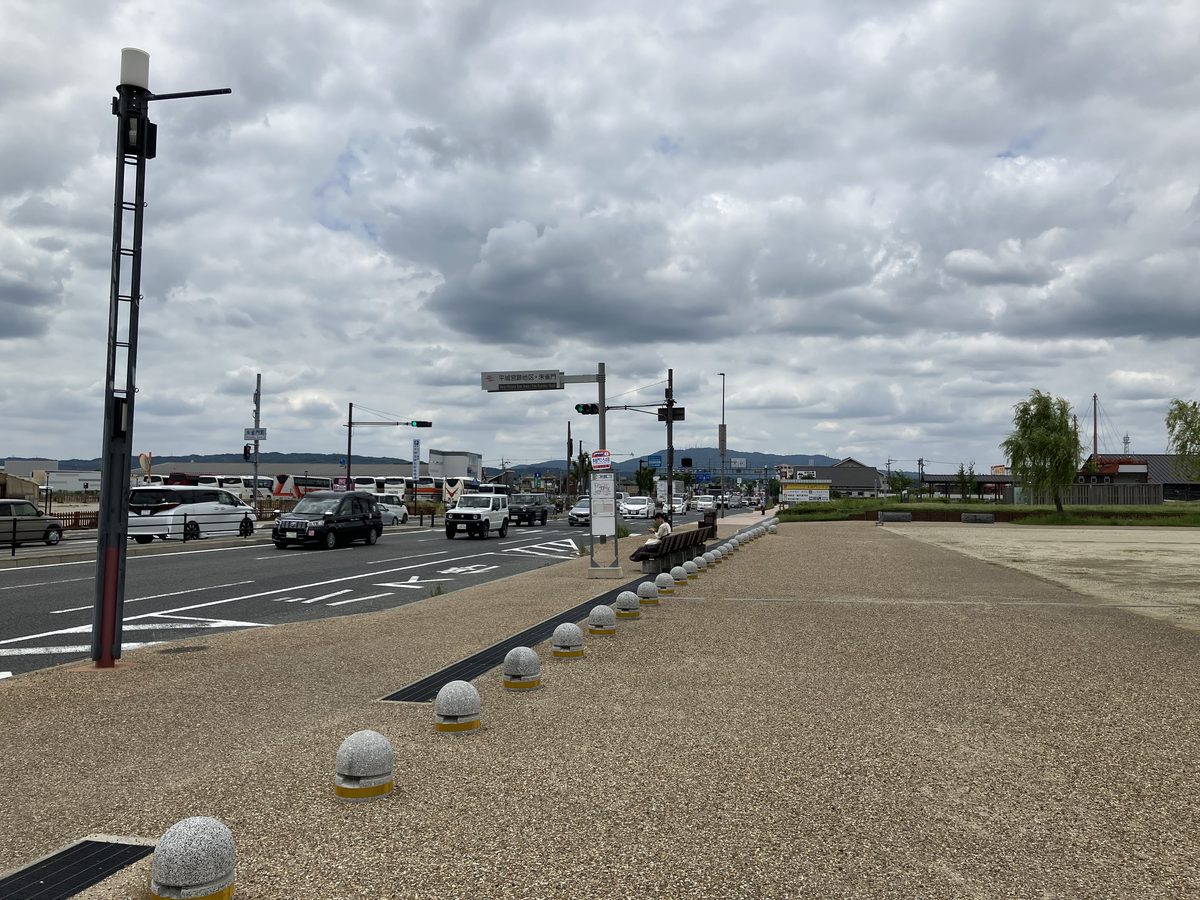
To Suzakumon Hiroba Square (By Bus: "Suzakumon-hiroba-mae")
On the Nara-Ikoma prefectural road, which runs east–west along the south side of Suzakumon Hiroba Square, there is a Nara Kotsu bus stop called "Suzakumon-hiroba-mae." It is about 6 minutes from the South Exit of Yamato-Saidaiji Station, about 16 minutes from Kintetsu-Nara Station, and about 10 minutes from the West Exit of JR Nara Station (according to the park; for bus stops, see the FAQ). On foot, it is about 20 minutes from the South Exit of Yamato-Saidaiji Station via the Tamate Gate.
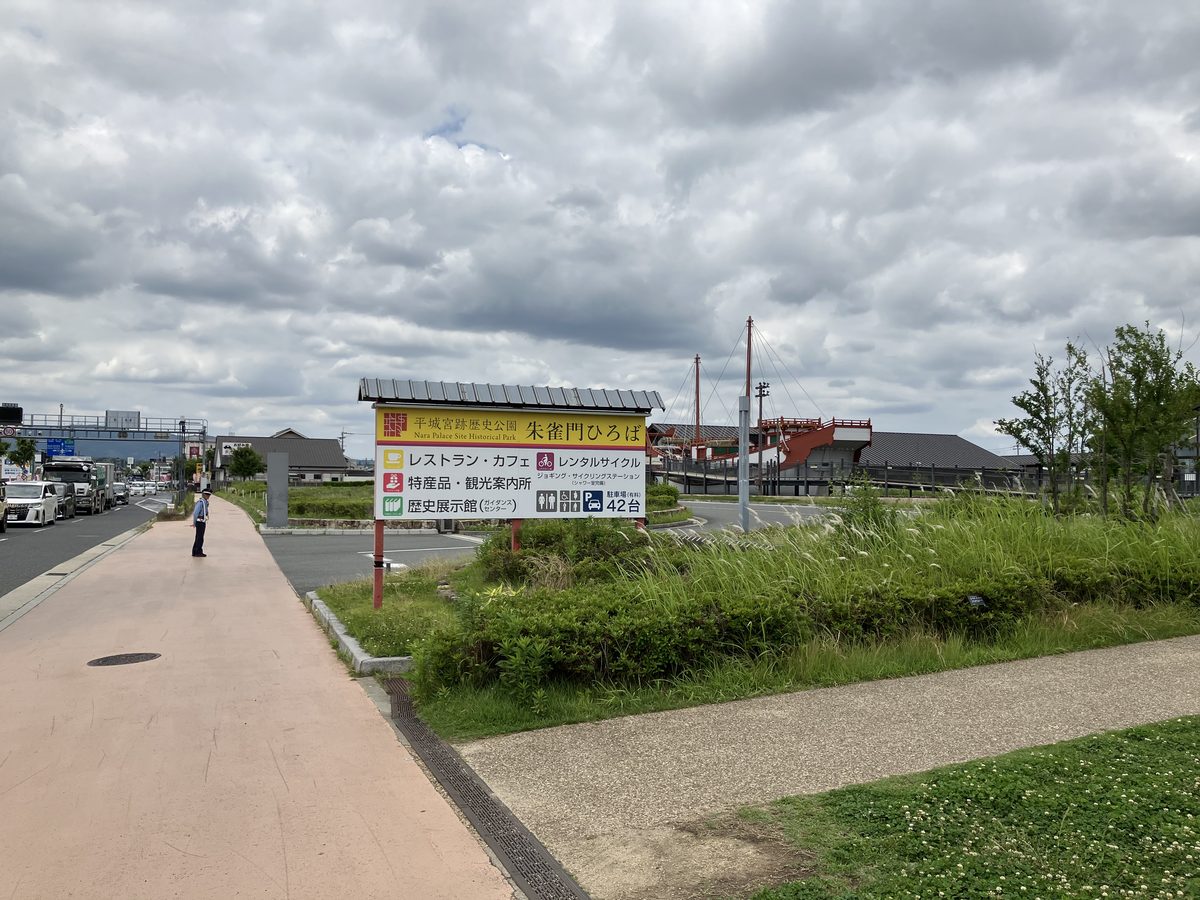
As the sign at the entrance shows, Suzakumon Hiroba Square brings together a restaurant and café, a shop for local products with a tourist information center, a history exhibition hall (guidance center) and bicycle rental. There is also a jogging and cycling station with showers and changing rooms — reassuring for runners, too.
Through Suzakumon Gate
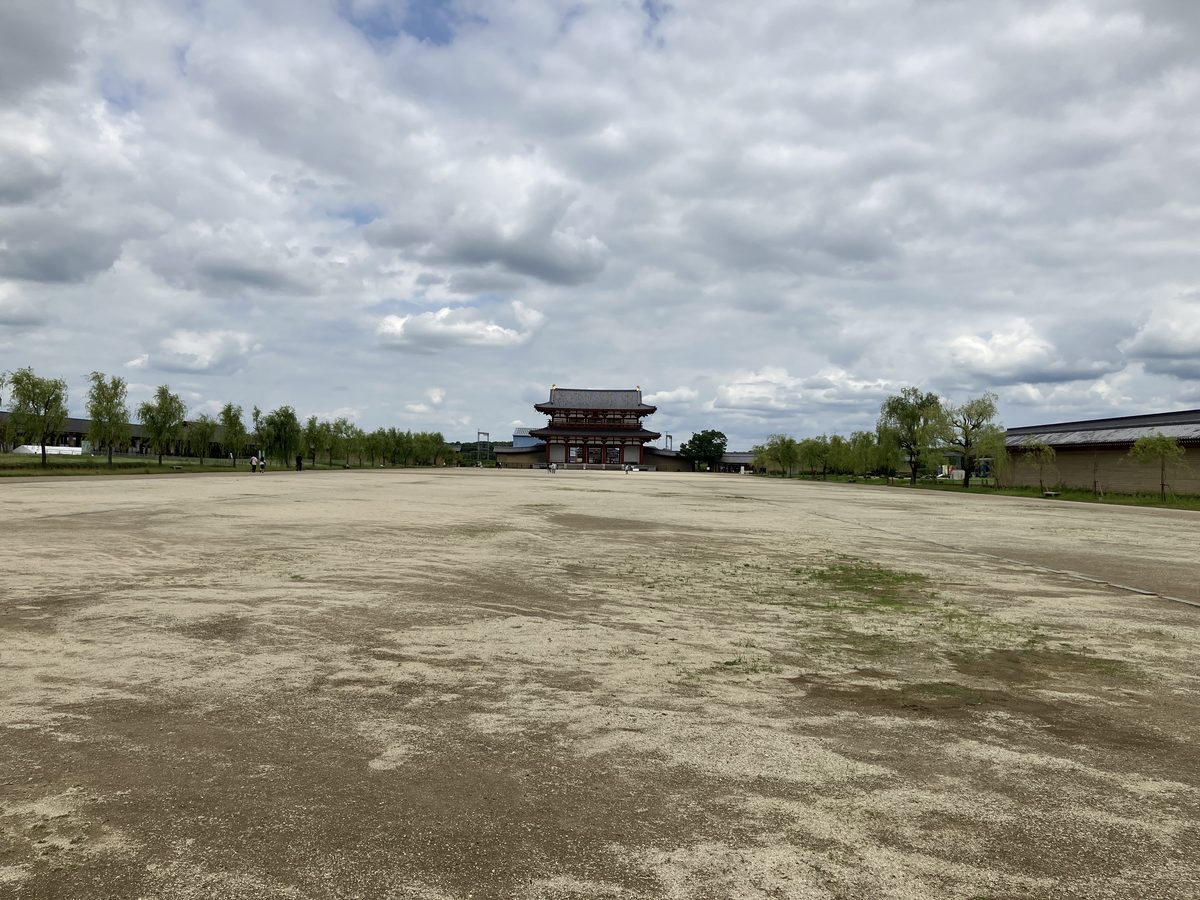
Walk north along the wide Suzaku Avenue and you reach Suzakumon Gate, the main gate of Heijo Palace. In the Nara period, it stood at the end of Suzaku Avenue — about 74 m wide — some 3.7 km north of the capital's entrance gate, Rajomon. It was restored in 1998. About 25 m wide and about 22 m high (according to the sign on site), it is an imposing two-story gate. The plaza in front of it was once a place of celebration, where foreign envoys were welcomed and seen off and large crowds gathered for song festivals.
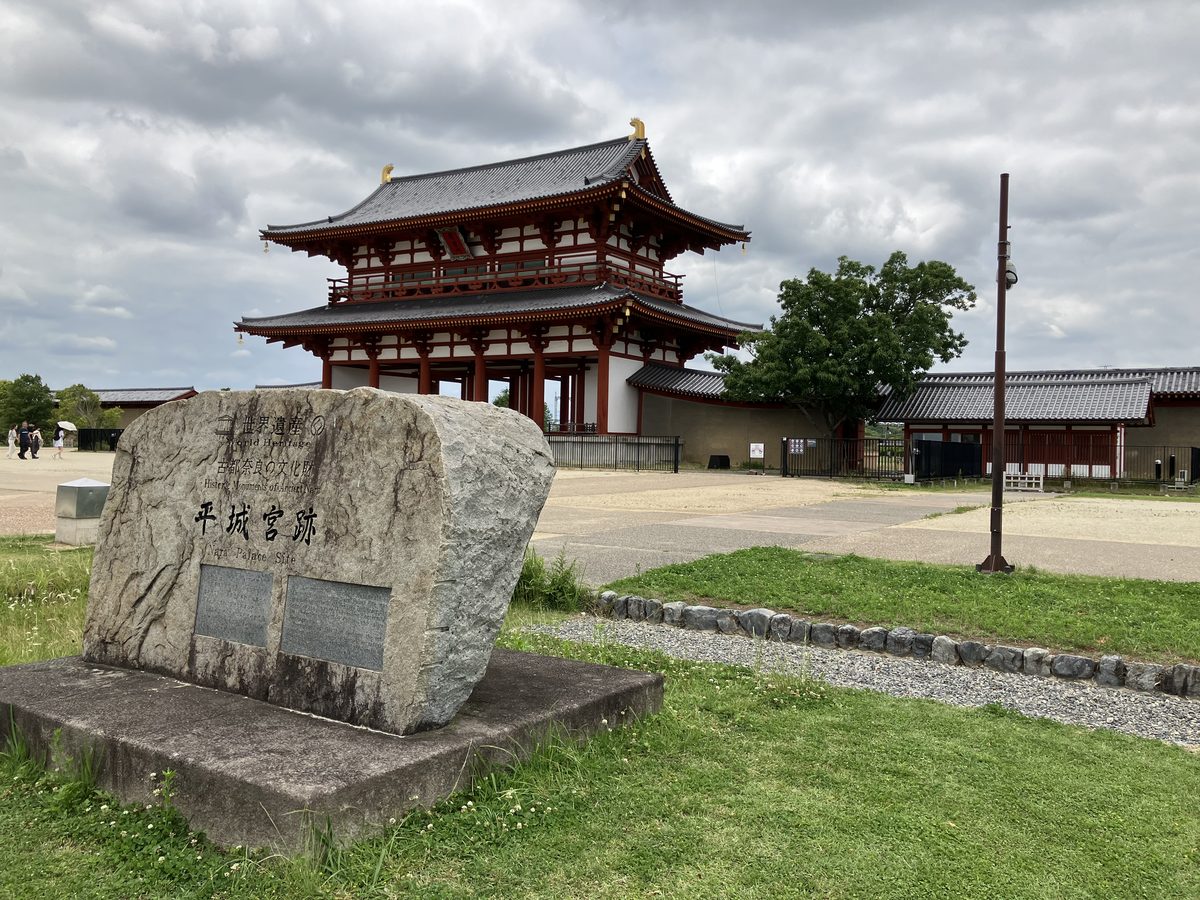
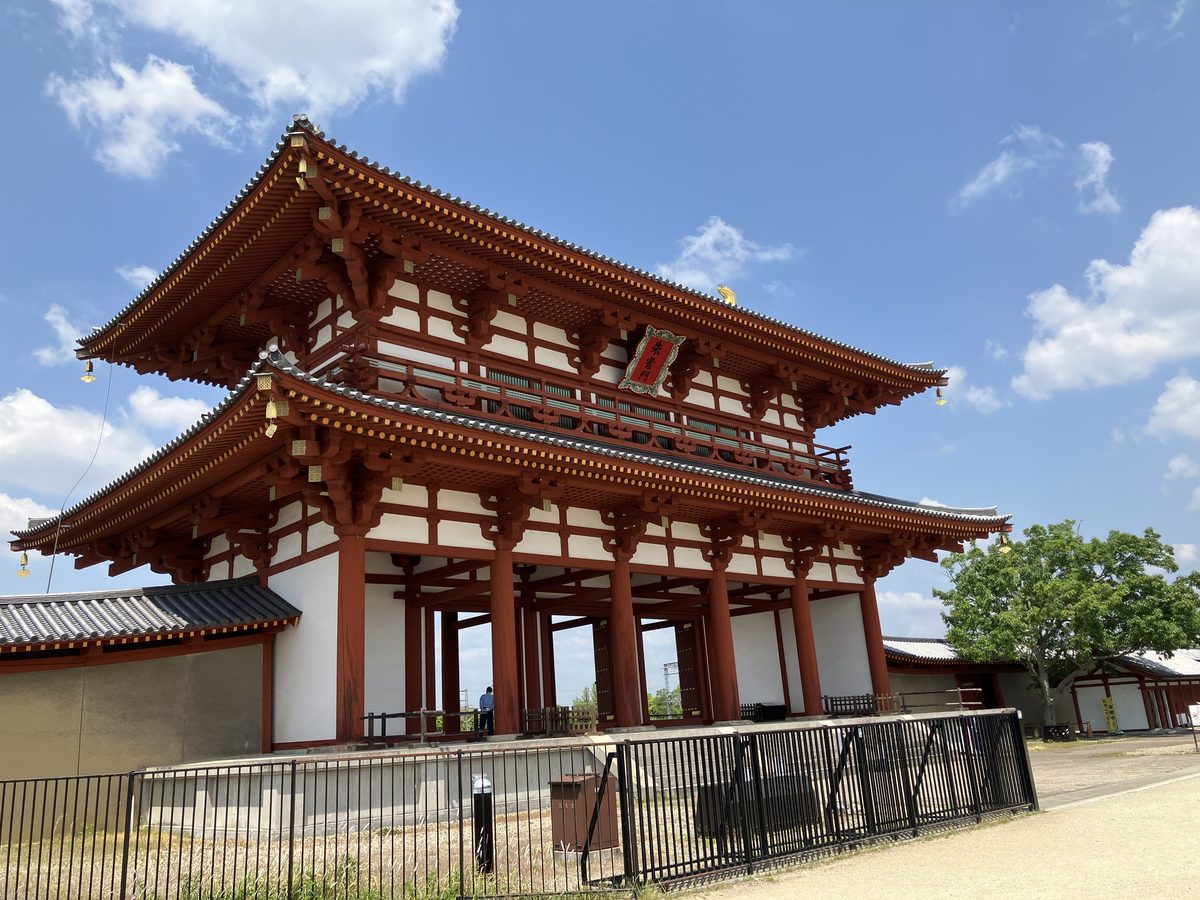
Guides are sometimes stationed around the gate. If you have any questions, feel free to ask them.
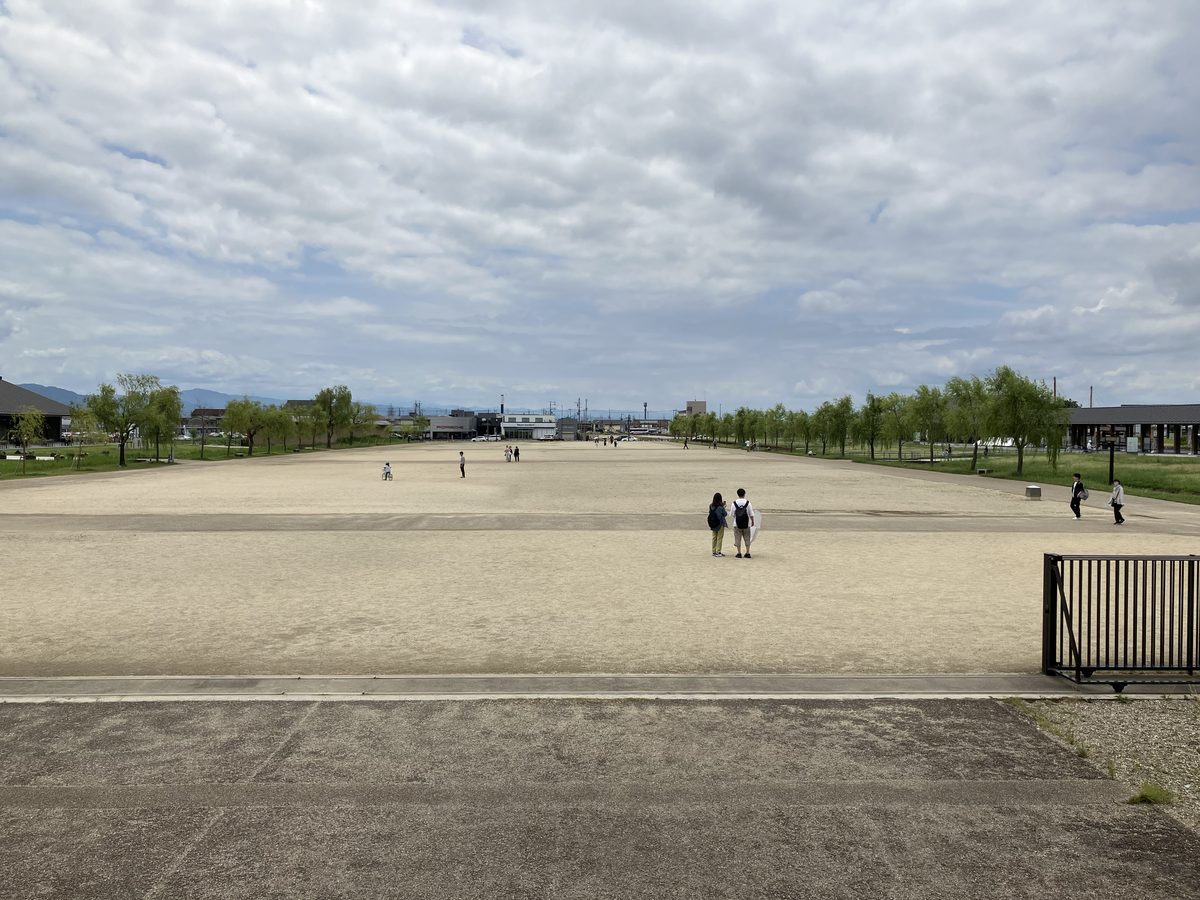
The View from Suzakumon Gate — the Palace Site and the Train
From Suzakumon Gate, turn north and look out toward the First Daigokuden. The vast landscape of the Heijo Palace Site spreads out before you.
And then watch the rare sight of a Kintetsu Nara Line train running through this World Heritage Site. The place you once saw from the train window — now you are the one standing in it.

Across the Railway Crossing to Daigokumon Gate and the East Tower
Cross the Kintetsu Nara Line at the railway crossing and keep walking straight north. From Suzakumon Gate to the First Daigokuden is about 800 m as measured on a map. The signposts along the way show the distance to each destination, which gives you a good sense of the scale.
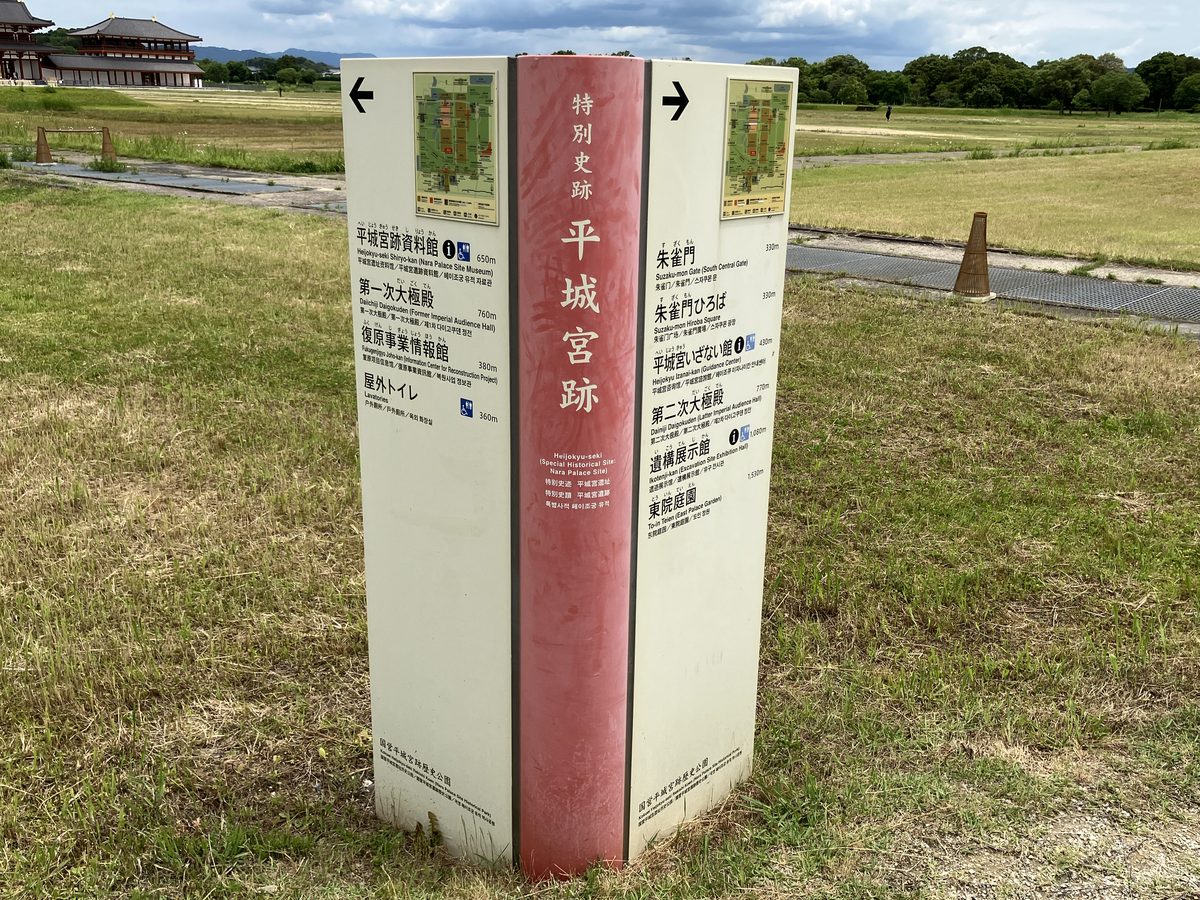
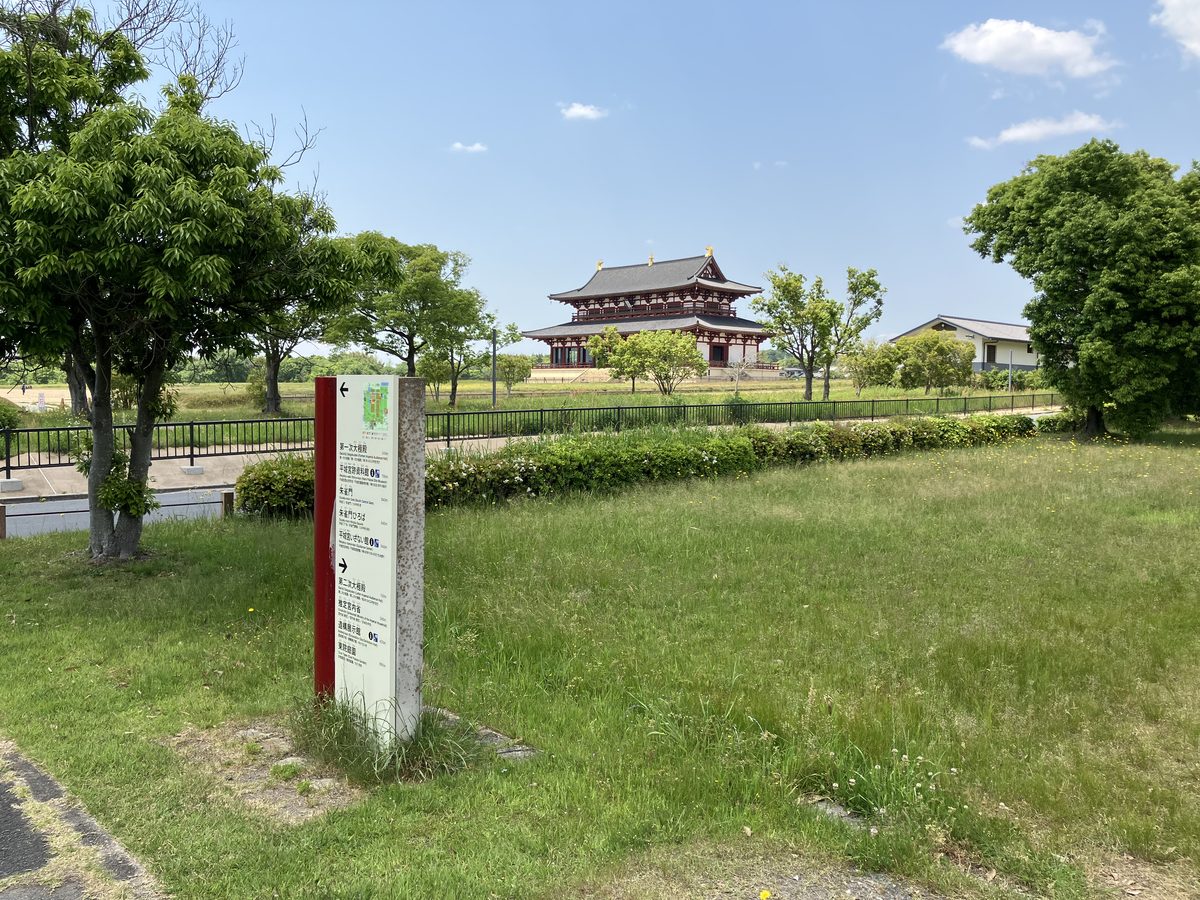
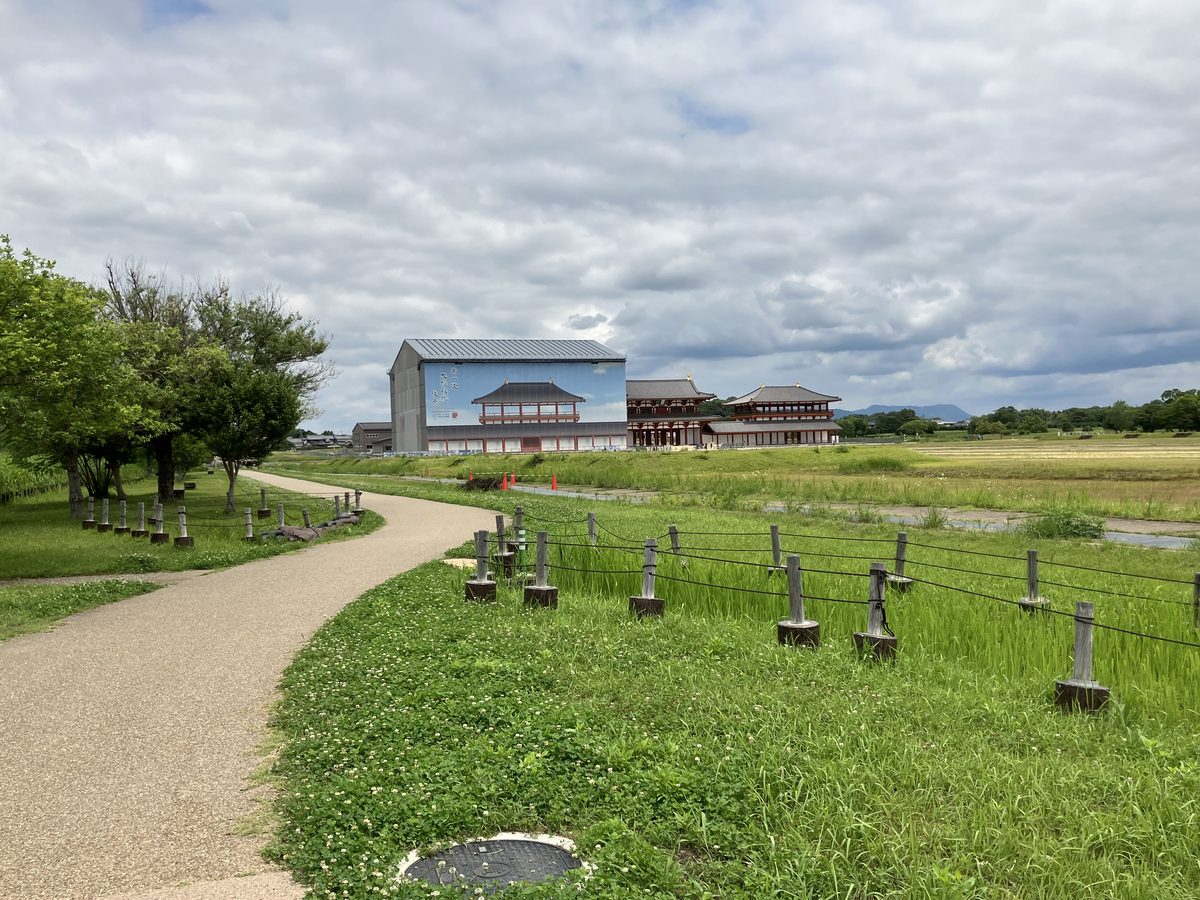
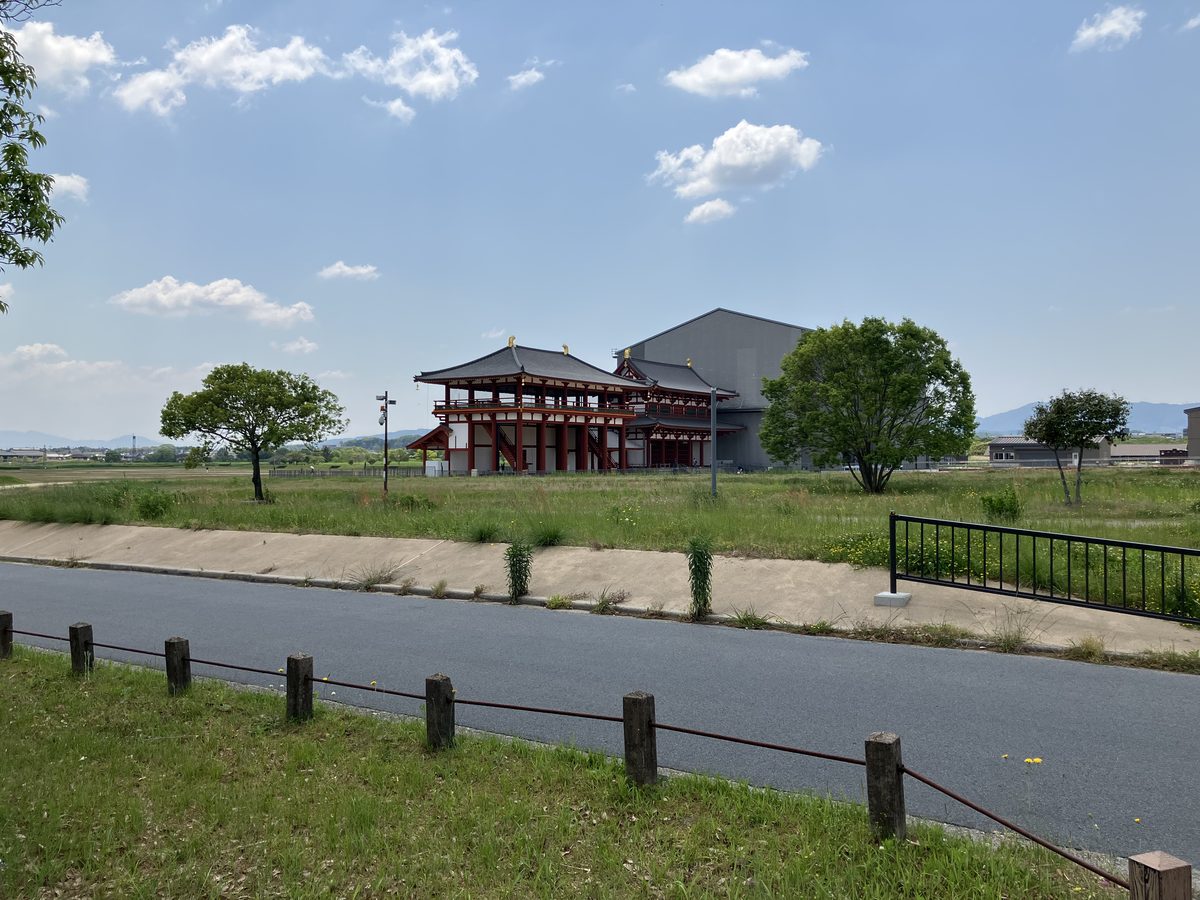
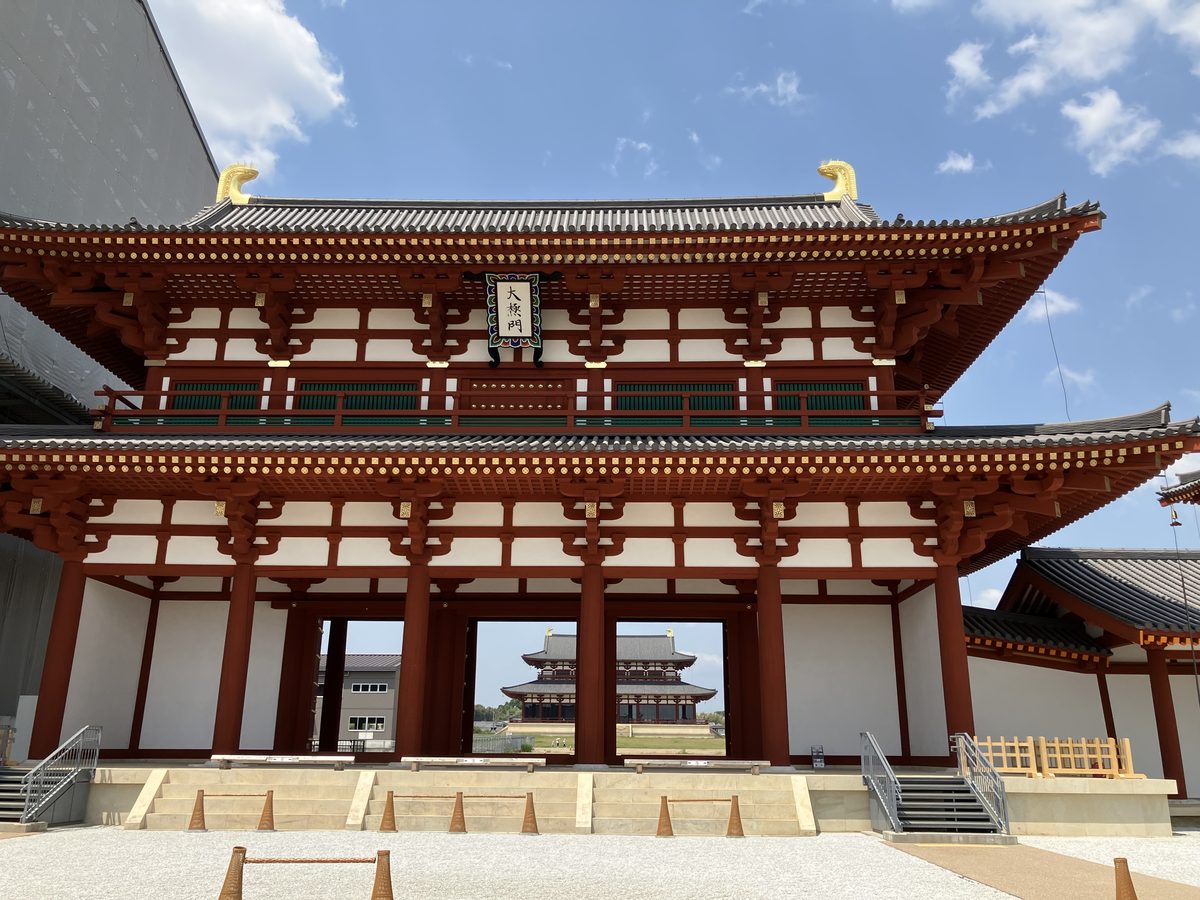
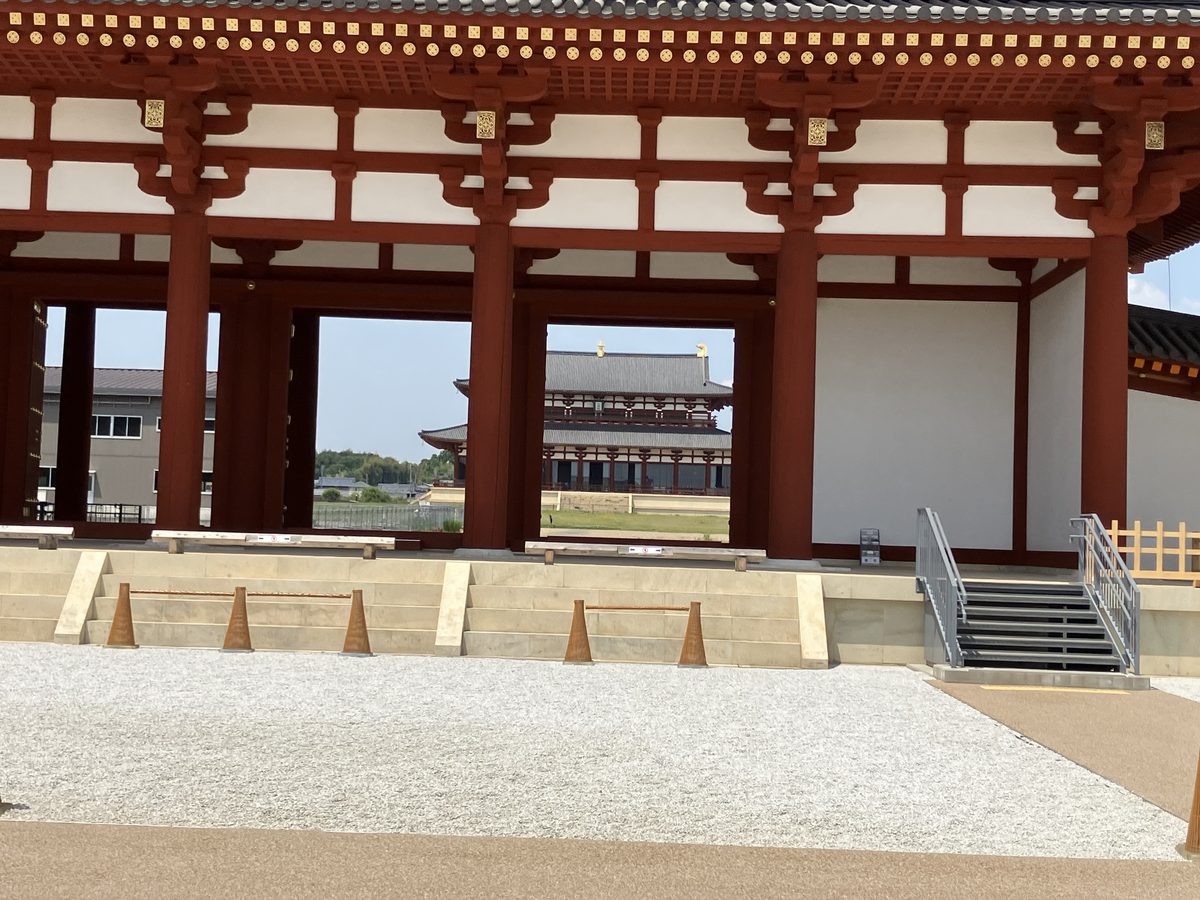
Standing in front of the First Daigokuden are Daigokumon Gate (completed in 2022), the main gate of the First Daigokuden compound, and the East Tower to its east (completed in March 2026). The East and West Towers are said to have been added around 730 to give the ceremonial grounds a more majestic look. The West Tower is still to be built, and for now a large construction cover (suyane) stands to the west of Daigokumon Gate. Guides are sometimes stationed here, too.
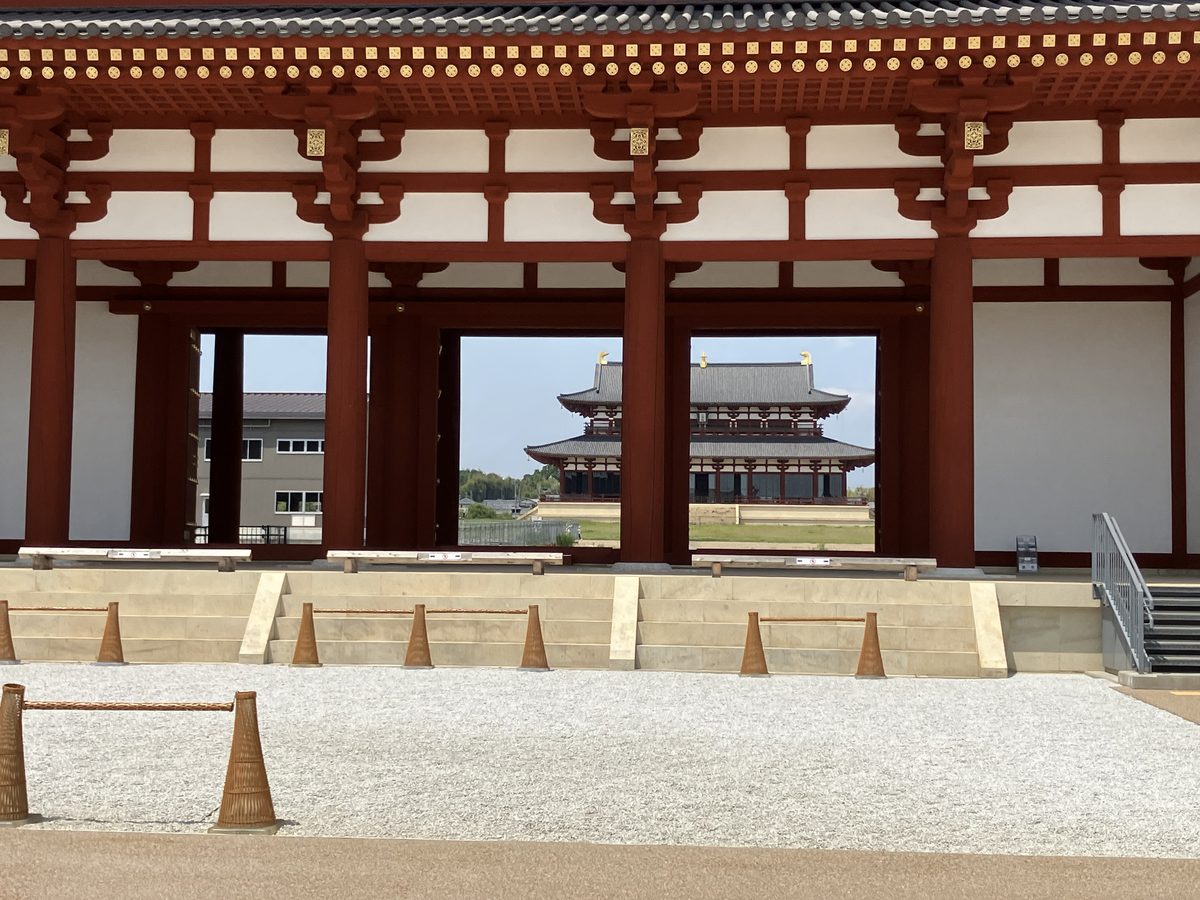
At Last, the First Daigokuden

The First Daigokuden (Former Imperial Audience Hall) is where the nation's most important ceremonies took place, such as enthronements, New Year's greetings to the emperor and audiences with foreign envoys. In 2010, the 1300th anniversary of the Nara capital, it was restored full-size on its original site. It is about 44 m wide, about 20 m deep and about 27 m high, with 44 vermilion pillars 70 cm in diameter and a roof of about 97,000 tiles — the largest building of Heijo Palace (according to the park).
Inside stands a full-size model of the Takamikura, the throne the emperor sat on during ceremonies, and the Four Guardian Gods and the twelve animals of the zodiac are painted high up on the walls on all four sides.
What I felt when I went inside was, above all, the sheer scale. And its splendor. I felt the long, long history this place has carried. Please come and see for yourself the power of those rows of vermilion pillars.
That is the classic route around the main highlights. It takes about 30 to 45 minutes.
After That, As You Like
After that, it is up to you. Take a leisurely walk around the grounds. Go back toward Suzakumon Hiroba Square and learn about the palace site at the Heijokyu Izanaikan Museum and other facilities. Have a meal or a rest at Tenpyo Umashikan, or shop for Nara specialties. Enjoy the envoy ship just beyond it. Or walk a little further east to visit Toin Teien (East Palace Garden).
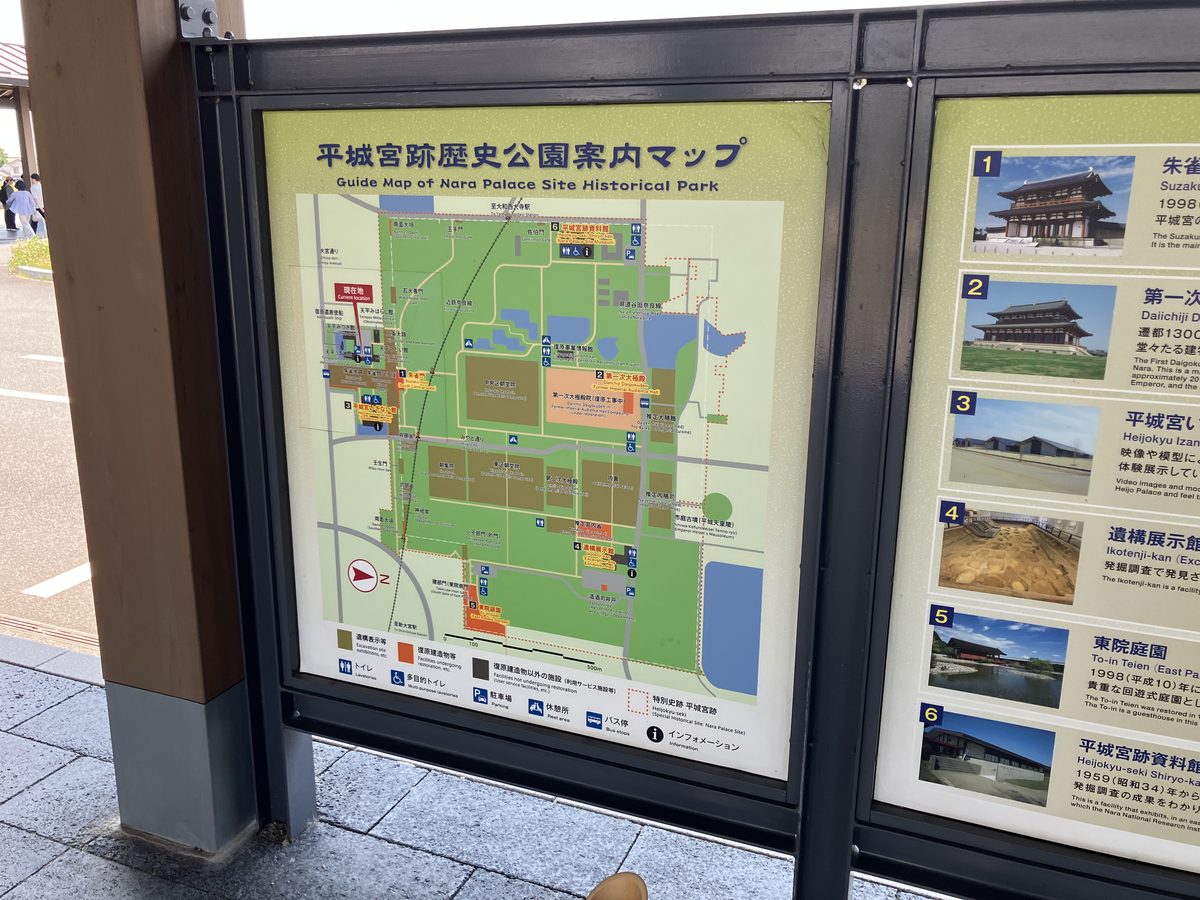
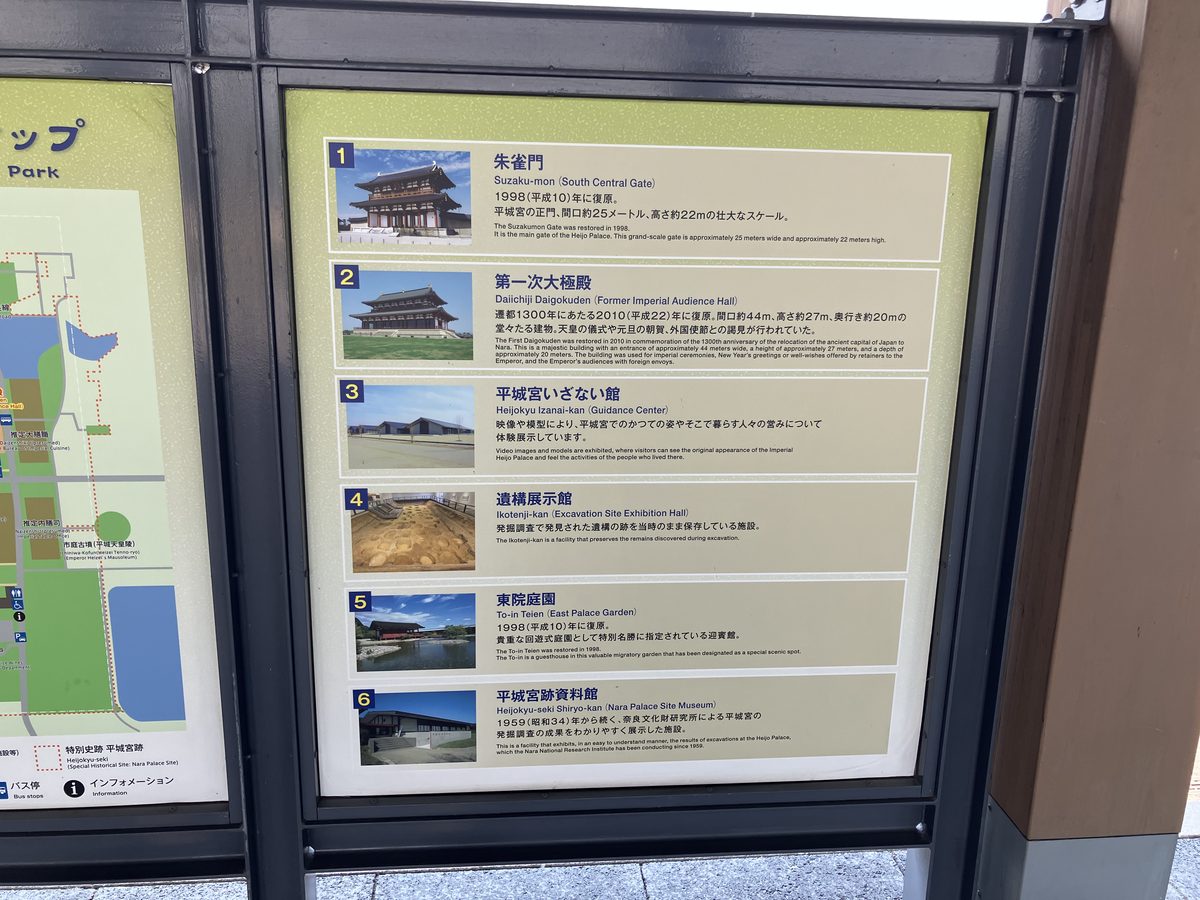
The Heijokyu Izanaikan Museum is a guidance center where you can experience Heijo Palace of the Nara period through a 1:200 model of the entire palace, a 1:5 model showing how the First Daigokuden was built, excavated artifacts and more (admission free).


At Tenpyo Umashikan, you can have a meal or a rest, and Nara specialties are on sale. Just beyond it, seeming to float on a pond, is the envoy ship.

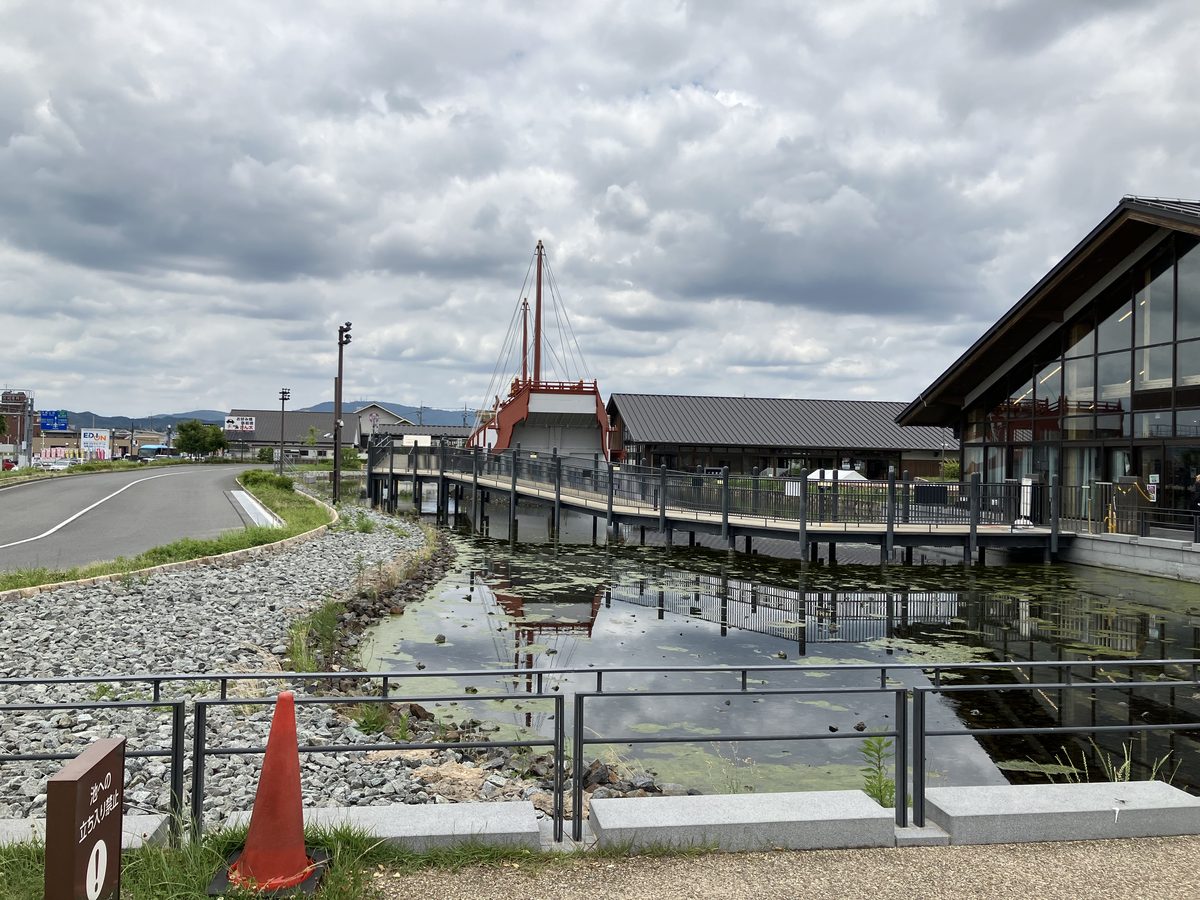
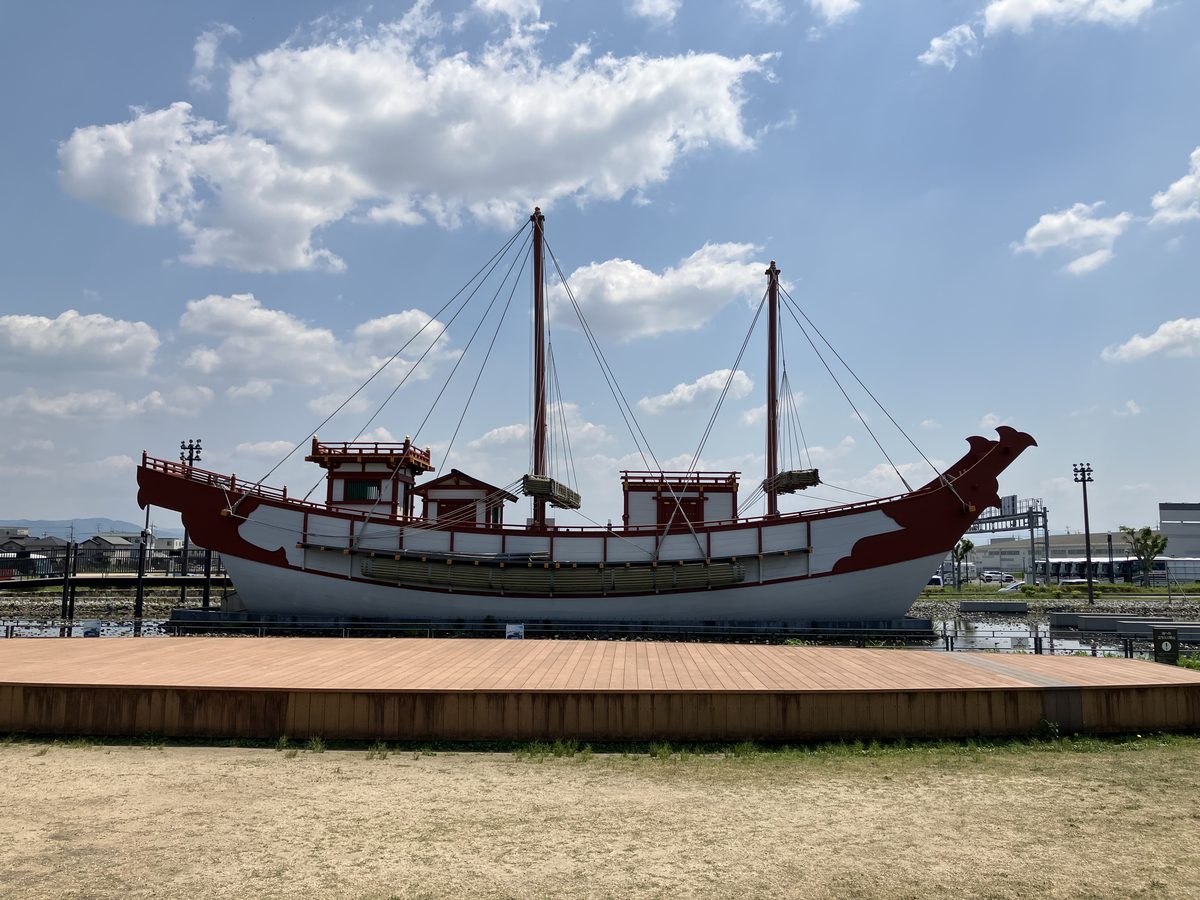
This envoy ship to Tang China was reconstructed for the 1300th Anniversary of the Nara Capital festival in 2010. According to the sign when I visited in June, going on board was free, from 8:30 to 17:50 (disembark by 18:00).
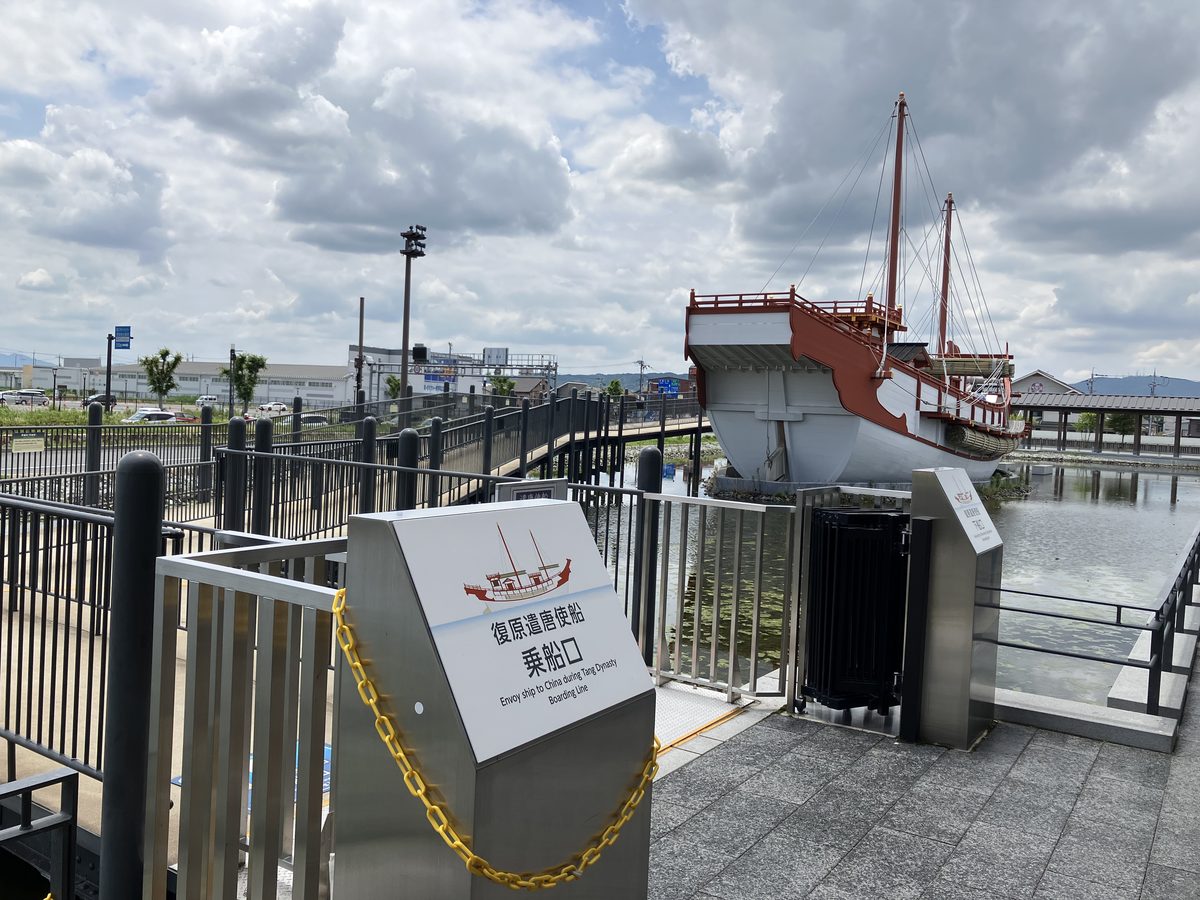
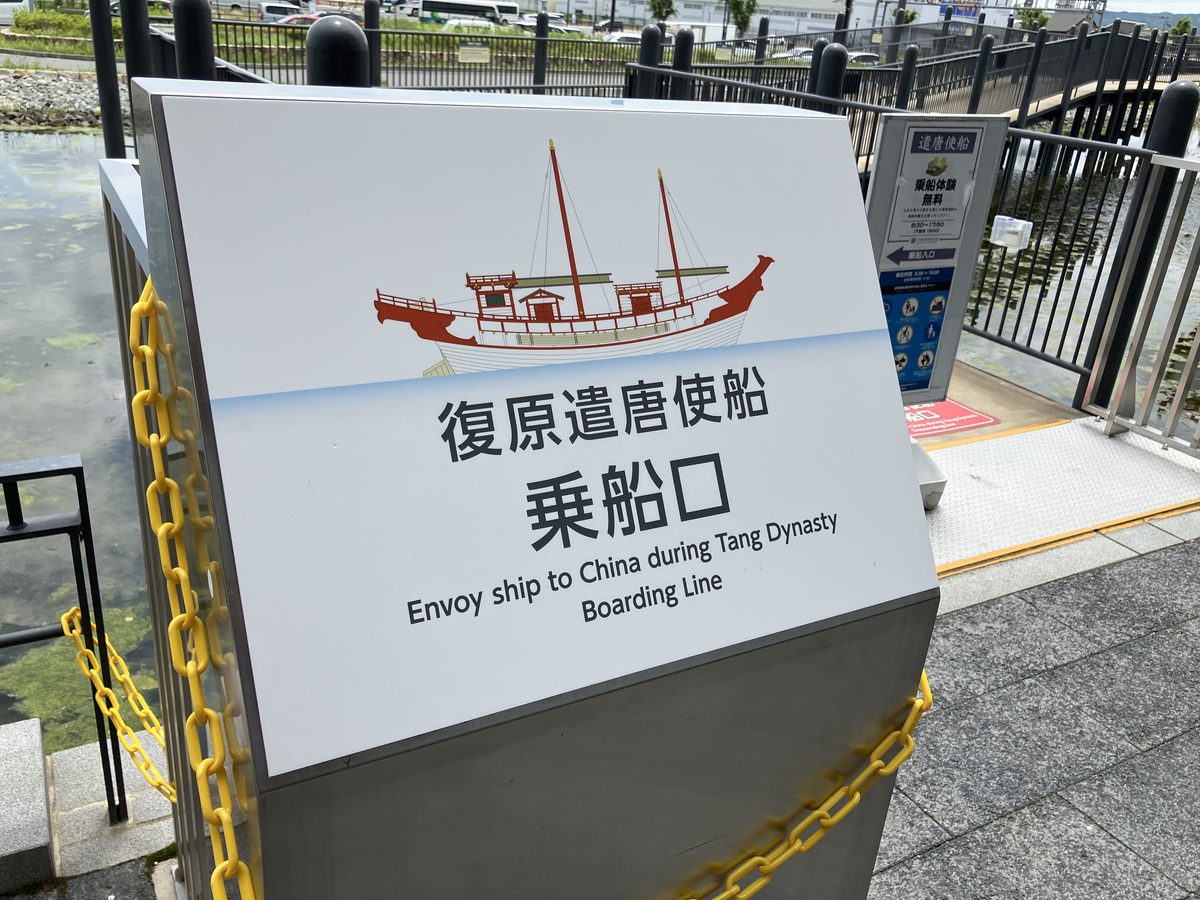
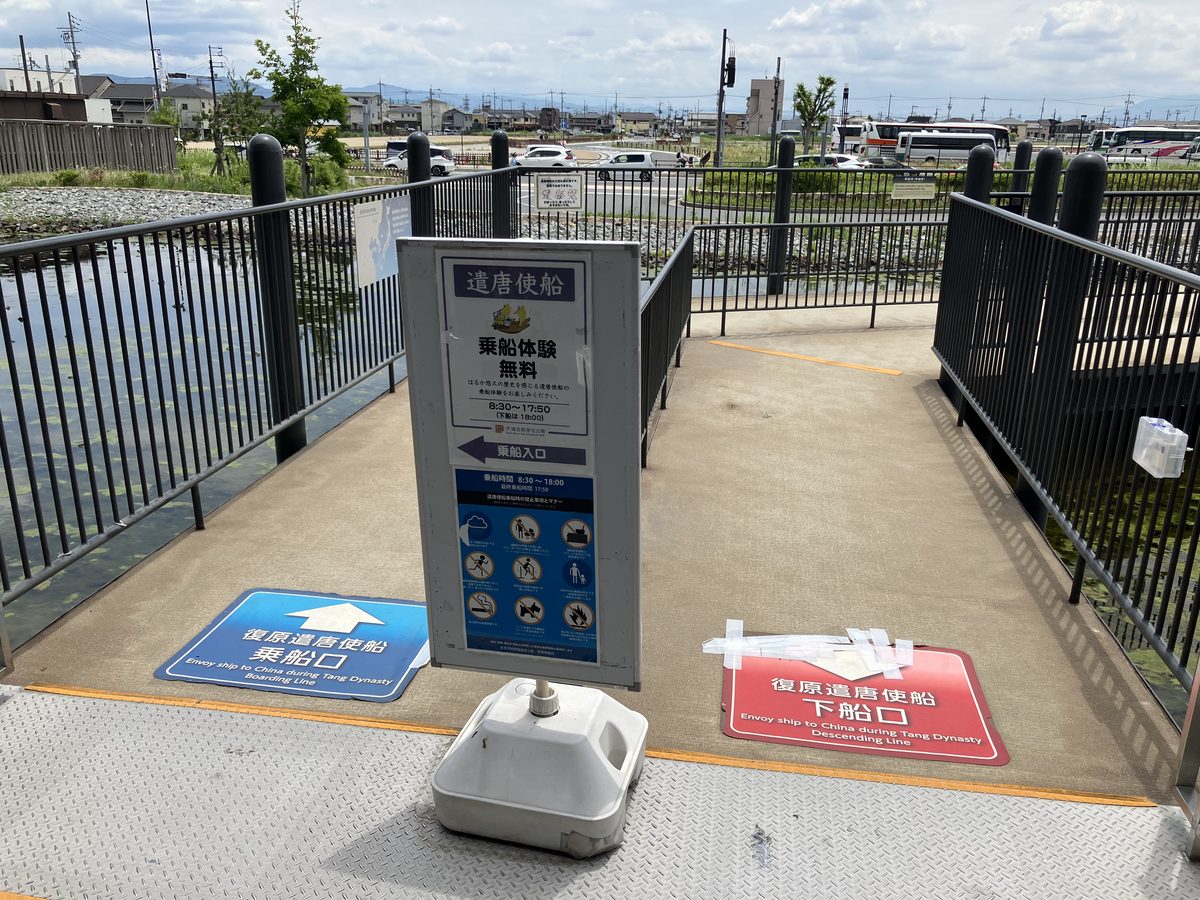
In the Nara period, envoys to Tang China set out on life-or-death voyages in ships like this. The embassy of 717 included Genbo, who later became head priest of Kairyuoji Temple (Article 7), and Abe no Nakamaro, who went on to serve at the Tang court. I wrote Nakamaro's story in Today's Wisdom: "Name Three Good Things from Today".
To the east of the First Daigokuden are the remains of the Second Daigokuden. It was used for about 40 years from 745, when the capital returned to Heijo-kyo, and its stone platform has been restored. From here you can see Mt. Wakakusa, Mt. Kasuga and more (according to the park).
Further east, the gate, earthen wall and buildings of the (presumed) Ministry of the Imperial Household — thought to be the office that served the imperial family — have been restored. Turn east around here, and there is Mt. Wakakusa in the distance. It is the same direction as the view of Mt. Wakakusa from the Karakuen garden of Hokkeji Temple; from around here, Hokkeji, Kairyuoji, Futaiji and Mt. Wakakusa line up almost in a straight east–west line.
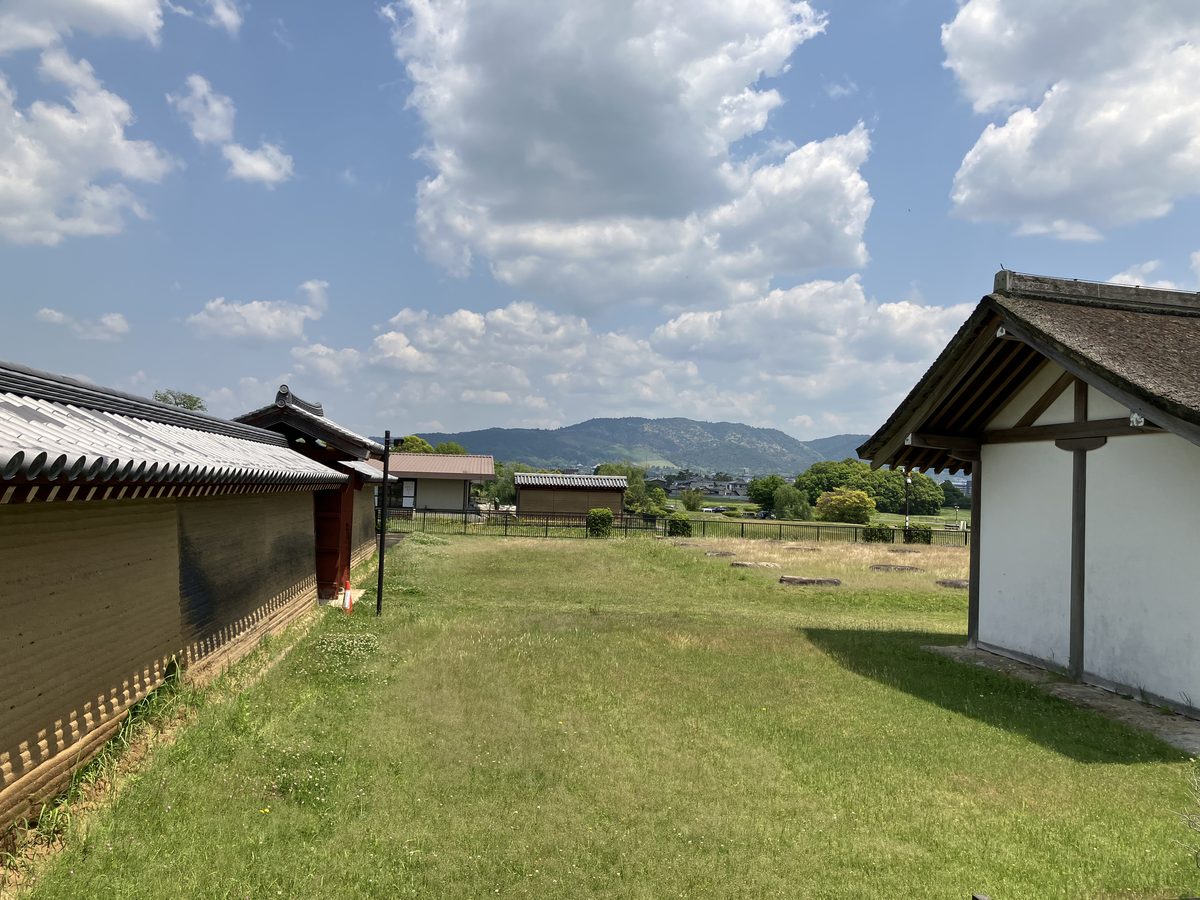
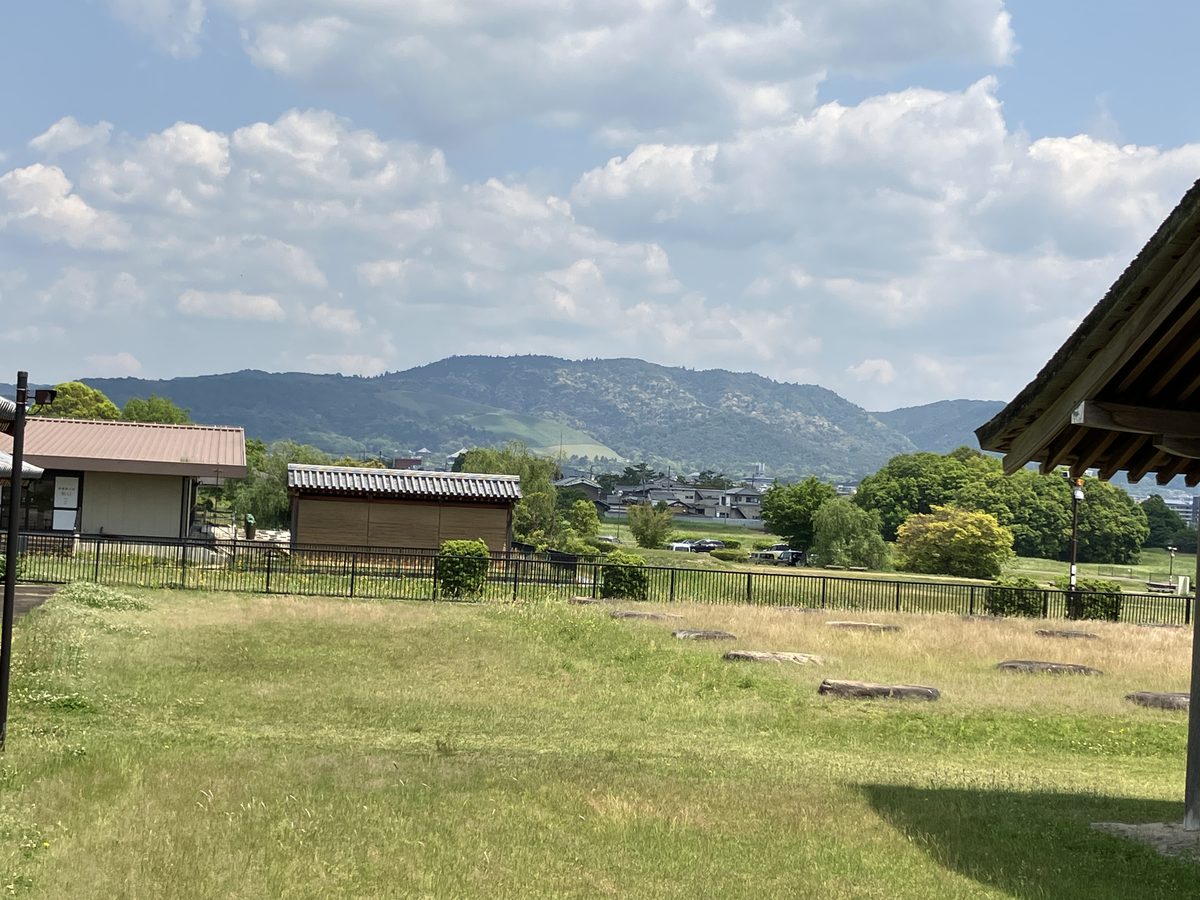
Toin Teien (East Palace Garden), in the southeast of the palace site, is a garden where banquets and ceremonies were held — playing a role like today's state guest house. It was restored in 1998 and is designated a Special Place of Scenic Beauty.
The Locals' Heijo Palace Site
The Heijo Palace Site is a World Heritage Site — and at the same time, a part of local people's everyday lives. Besides people walking and jogging, you will see mini soccer, games of catch, jump rope and tag, little children on mini field trips, people walking their dogs, practicing instruments or singing, sketching, napping, picnicking, and, in cherry blossom season, hanami picnics. Corporate ekiden relay teams and junior and senior high school sports clubs train here, too. In recent years, I have also started to see overseas visitors walking and jogging here.
One lap around the palace site is about 4.5 km, calculated from its size. Even walking or jogging, that is quite a workout!


Truly, if 100 people come, there are 100 ways to enjoy it — and this place embraces them all with its generous heart.
Visitor Information — Hours, Admission, Closures
| Admission | Free (all facilities in the park are also free) |
|---|---|
| First Daigokuden, Suzakumon Gate, Toin Teien, Excavation Site Exhibition Hall, etc. | 9:00–16:30 (last entry 16:00) Closed: Mondays (the following weekday if Monday is a public holiday) and the New Year holidays |
| Heijokyu Izanaikan Museum, Daigokumon Gate, East Tower, etc. | 9:00–17:00 (last entry 16:30) Closed: the second Monday of February, April, July and November (the following day if it is a public holiday) and December 29 – January 1 |
| Envoy ship boarding | Free (8:30–17:50 according to the sign when I visited in June; disembark by 18:00) |
| Time needed | Classic route from Suzakumon Hiroba Square to the First Daigokuden: 30–45 minutes |
| Coin lockers | Heijokyu Izanaikan Museum, Tenpyo Tsudoikan and Nara Palace Site Museum |
| Bus | Nara Kotsu bus to "Suzakumon-hiroba-mae" (for bus stops, see the FAQ) |
| Nearest station | Kintetsu Yamato-Saidaiji Station (about 20 minutes on foot from the South Exit to Suzakumon Hiroba Square) See also the step-by-step photo routes from Hokkeji and Yamato-Saidaiji Station |
| Parking | A prefectural car park (paid), plus free car parks at the Museum, the Excavation Site Exhibition Hall and Toin Teien |
* Checked on the official website of Nara Palace Site Historical Park in October 2026. The time needed is my (Masaru's) estimate. Facilities may close on certain days or have restrictions during events, so please check the "News" on the official website before you go.
Visiting on a Monday? The First Daigokuden, Suzakumon Gate, Toin Teien and some other facilities are closed on Mondays (the following weekday if Monday is a public holiday). The Heijokyu Izanaikan Museum, Daigokumon Gate and the East Tower are usually open on Mondays, but they have their own closing days.
How I Recommend Visiting — After the Three Temples
My recommendation is a day of walking from Futaiji (Article 6) to Kairyuoji (Article 7) and Hokkeji (Article 8), finishing at the Heijo Palace Site — and then heading back to Kyoto or Osaka from Yamato-Saidaiji Station.
From Kyoto or Osaka, first take a Kintetsu Limited Express to Kintetsu-Nara Station. On Klook, you can book a Kintetsu Limited Express digital ticket (Kyoto → Kintetsu-Nara or Osaka-Namba → Kintetsu-Nara) in advance on your smartphone (see the ad below).
Ad
Of course, as I said above, you are just as welcome to visit only the Heijo Palace Site and spend your time there however you like.
For Lunch
- At Tenpyo Umashikan in Suzakumon Hiroba Square.
- On a nice day, buy some rice balls or a bento and enjoy them on a bench or a picnic sheet in the grounds (fire and smoking are not allowed in the park).
- Back at Yamato-Saidaiji Station, at Nara Family, a shopping complex just outside the North Exit (with Kintetsu Department Store Nara and more).
- At Time's Place Saidaiji, inside the ticket gates of Yamato-Saidaiji Station.
- At the hotels introduced below, or near Nara City Hall.
A Morning Walk, an Evening Walk
If you love mornings, in the quiet morning air. If you love evenings, bathed in the setting sun. At the Heijo Palace Site, people walk and jog at whatever time of day they like best.
Many visitors from overseas love walking and jogging, don't they? Why not stay at a hotel nearby, so you can enjoy that time here?
🏨 Staying Overnight in Nara?
One of the closest hotels to the Heijo Palace Site is Kamenoi Hotel Nara. It stands right next to the west side of the palace site, and you can walk into the grounds in about 2 minutes from the hotel. It has a natural hot spring, and there is a free shuttle from the South Exit of Yamato-Saidaiji Station (reservation required by the day before; according to the hotel). The Nara Royal Hotel, introduced in Articles 6–8, is close to the east side of the palace site, and Novotel Nara and JW Marriott Hotel Nara, introduced in Article 5, are not too far away either. These four hotels can be booked on Klook.
Ad
You can also search for and book other hotels and ryokan (Japanese inns) in Nara on Klook. Below are some of the places to stay in Nara listed on Klook.
Ad
Seasonal Pleasures
In cherry blossom season in spring, the grounds are lively with families and groups of friends spreading out picnic sheets for hanami. I love that cheerful cherry blossom season, too.
But what I love even more is autumn — walking through the Heijo Palace Site lit by the setting sun, in the season when the pampas grass comes into ear. I love the slightly wistful atmosphere, like the First Daigokuden glowing in the evening sun.
The season I don't recommend is midsummer. You will only end up wilting in the shade of a tree (laughs). In fact, once when I visited on a summer afternoon, I was caught in a pouring evening thunderstorm, took shelter in a building in the grounds, and waited and waited for the storm to pass.
The Heijo Palace Site shows many different faces — it is a treasure trove of nature, too.
FAQ
How much is admission to the Heijo Palace Site?
It is free. Admission to all the facilities in the park — including the First Daigokuden, Suzakumon Gate and the Heijokyu Izanaikan Museum — is also free.
How much time do I need?
The classic route — from Suzakumon Hiroba Square through Suzakumon Gate, past Daigokumon Gate and the East Tower, to the First Daigokuden — takes about 30 to 45 minutes. If you also want to visit the Heijokyu Izanaikan Museum, the envoy ship or Toin Teien, allow more time. One lap around the palace site is about 4.5 km.
Can I visit on a Monday?
The First Daigokuden, Suzakumon Gate, Toin Teien, the Excavation Site Exhibition Hall and some other facilities are closed on Mondays (the following weekday if Monday is a public holiday). The Heijokyu Izanaikan Museum, Daigokumon Gate, the East Tower and some others are closed on the second Monday of February, April, July and November (the following day if it is a public holiday) and from December 29 to January 1.
Where can I see the Kintetsu train running through the palace site?
Look north from Suzakumon Gate, and you will see the tracks crossing the palace site and the trains running along them. When you are on the train, it passes through the palace site between Yamato-Saidaiji and Shin-Omiya Stations.
Are there coin lockers?
Yes — at the Heijokyu Izanaikan Museum, Tenpyo Tsudoikan and the Nara Palace Site Museum (according to the park).
Can I eat a packed lunch there?
Yes, you may bring a packed lunch (according to the park). However, eating and drinking are not allowed inside some facilities, and fire and smoking are prohibited in the park.
Can I go on board the envoy ship?
Yes. According to the sign when I visited in June, boarding was free, from 8:30 to 17:50 (disembark by 18:00). Times may change, so please check the information on site.
Can I get there by bus?
Yes. Take a Nara Kotsu bus (route 160 or 164) to "Suzakumon-hiroba-mae": about 6 minutes from the South Exit of Yamato-Saidaiji Station (stop No. 12, bound for Takabatake-cho), about 16 minutes from Kintetsu-Nara Station (stop No. 11, bound for Gakuemmae Station South) and about 10 minutes from the West Exit of JR Nara Station (stop No. 13, bound for Gakuemmae Station South) (according to the park). Please check times and fares on the Nara Kotsu website.
The Appeal of Heijo Palace Site
How did you enjoy this report?
Starting with Futaiji (Article 6), then Kairyuoji, Hokkeji and now the Heijo Palace Site, I have introduced this area over four articles.
Part of a World Heritage Site, yet woven into local people's everyday lives, with a train running across its grounds — it is a rare place, even by world standards.
With its long, long history, the Heijo Palace Site gently embraces everyone, from local residents to visitors from all over the world. Please stay nearby, and enjoy a walk or a jog here at whatever time you like.
And the next time you see the Heijo Palace Site from the train window, please do get off along the way.
This blog will continue to share places with real character that most people never notice — please come and see them with your own eyes.
Enjoy the Vast World Heritage, Heijo Palace Site 🏛️
Please enjoy Heijo Palace Site in your own way — take a stroll, go for a jog, or simply sit and let the ancient air wash over you.
Surely, your own unique Nara is waiting for you.
Life is a journey. Let's walk it slowly, together.