Reflect on Why It Happened, and Act So It Never Happens Again
The Nara Basin is a land of little rain. Its yearly rainfall is only about 1,300 to 1,400 millimeters, and since old times people here have relied on irrigation ponds for almost all of their water, carefully sharing it out to their rice fields. In years when the weather in Yamato is kind, other regions tend to have too much rain, and in years when other regions enjoy good harvests, Yamato suffers from drought. The old saying Yamato honen kome kuwazu, roughly, a bumper year for Yamato, yet no rice to eat, is said to describe this shortage of water.
Just over the mountains to the south, the Yoshino River flows full, gathering the rain that falls on the Yoshino mountains. In the Genroku era of the Edo period, Takahashi Sasuke, a village headman of Nagara in Katsuragi District, now part of Gose City, is said to have thought of a plan to bring this river's water into the basin. But the Kishu domain, through which the river flows on downstream as the Kinokawa, feared that drawing the water upstream would leave less for them, and no agreement was reached. Through the Meiji, Taisho and Showa eras that followed, surveys were made and plans were drawn up, only to be turned down again and again.
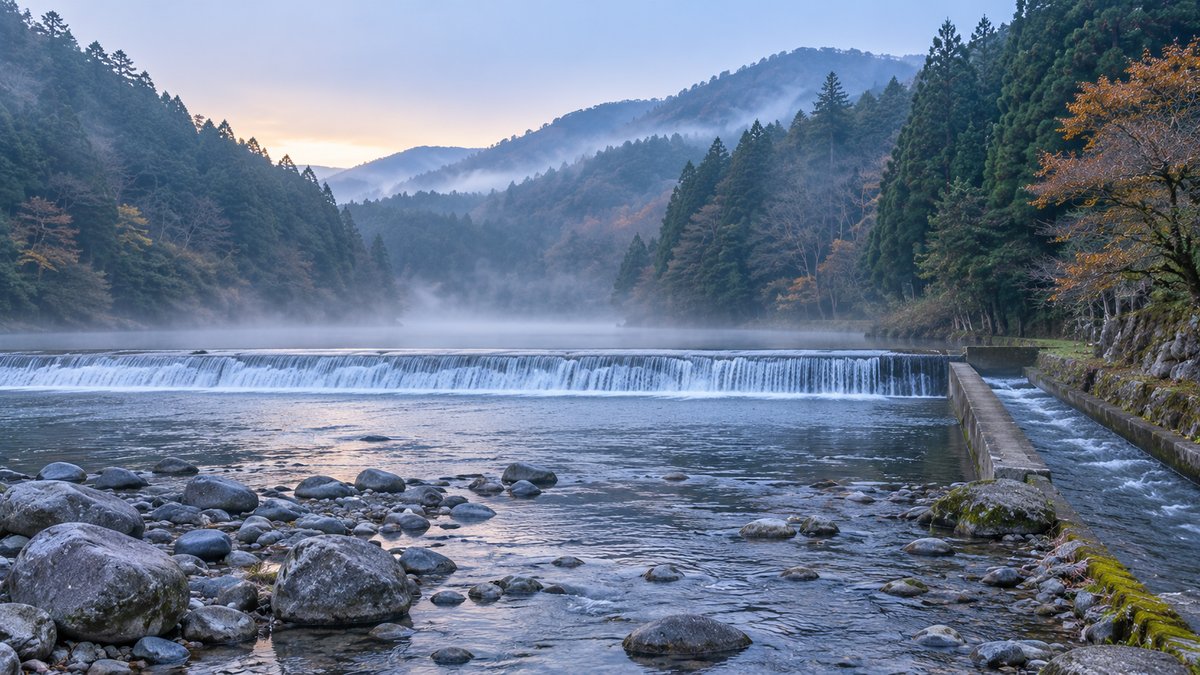
Construction finally began in 1952, the twenty-seventh year of Showa, as a plan to ease the water shortage of both the Yamato and Kii plains together. Dams were built and tunnels were dug through the mountains. The Shimobuchi Head Works, which divides the water of the Yoshino River, was completed at Shimobuchi in Oyodo Town, Yoshino District, in 1974. Some three hundred years had passed since Sasuke's idea.
In life, you will sometimes find yourself in a situation where 'there is no point in fussing now over what has already happened. What matters first is how to solve this problem.'
That is certainly true, and what comes first is how quickly you can deal with the problem that has arisen.
However, even if it is after things have settled down, it is very important to look back on why such a thing happened and to take steps so that it never happens again.
Otherwise, you will repeat the same thing, and each time you will end up saying, 'There is no point in fussing now over what has already happened. What matters first is how to solve this problem.'
That is nothing but the height of folly.
At Shimobuchi, part of the Yoshino River's water is still quietly set aside, passes through the tunnels, and is carried over the mountains to the basin beyond. In the basin, some 4,300 irrigation ponds, large and small, still hold their water and remain an important source alongside it. To the basin that once waited anxiously for rain in every year of drought, the water that fell on the Yoshino mountains now arrives, for the fields and for daily life.