To Gain Something, You Must First Let Something Go
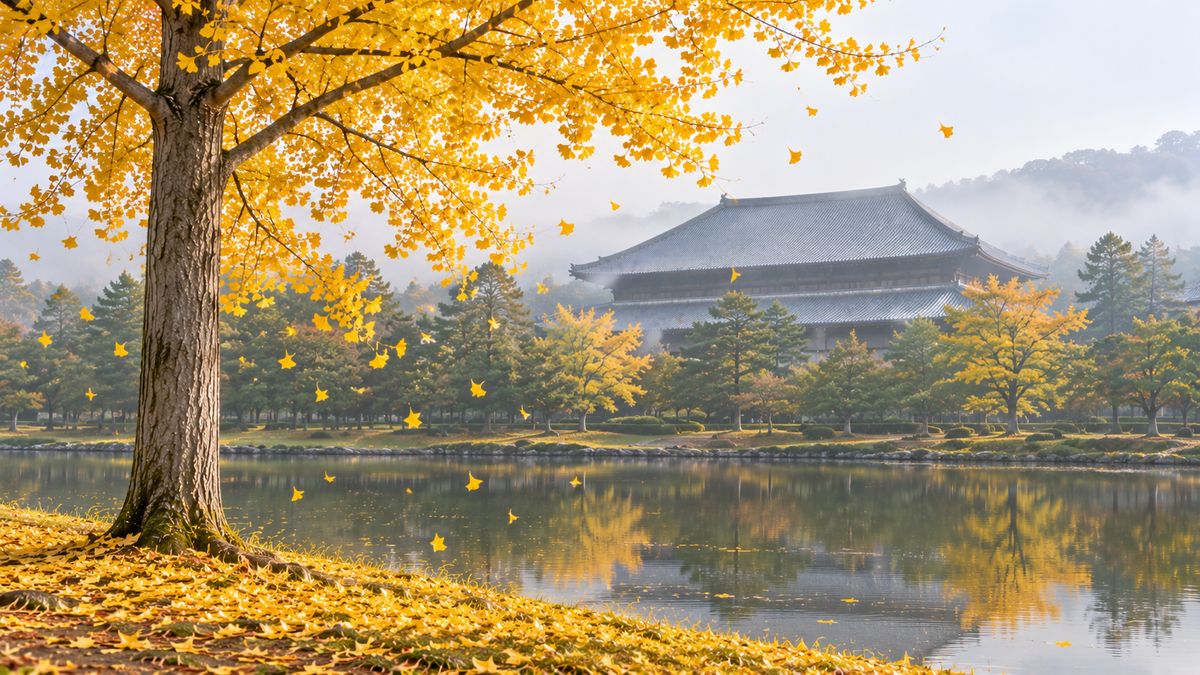
A short walk northwest of the Great Buddha Hall of Todai-ji lies a pond called Daibutsu-ike. The approach from the Nandaimon Gate to the Great Buddha Hall is always crowded with people, but out here the voices fade into the distance. Trees grow thick around the pond, and beyond the still water, the great roof of the Great Buddha Hall can be seen.
As autumn deepens, the trees along the pond turn red and yellow. The ginkgo trees, above all, color their fan-shaped leaves yellow all the way to the tips of the branches. These are the leaves that opened in spring and, through the strong summer sun, kept nourishing the tree the whole time.
As the days grow shorter and the mornings and evenings turn cold, the tree forms a thin partition at the base of each leaf, called the abscission layer. There, the paths for water and nutrients are quietly shut off. The leaves, now easily parted from the branches, drift down one by one onto the edge of the pond with every breeze.
Suppose you want to gain something new.
What would you do at such a time?
Are you not trying to chase after something new while still holding on to what you have now?
If so, gaining something new will probably not be easy.
And even if you manage to gain it by forcing yourself, you may be losing something else.
What matters is this: 'To gain something, you must first let go of something.'
In other words, 'You do not let go of something after you have gained something.'
Of course, if what you have now satisfies you, there is no need to let go of anything.
That is for you to decide.
Put the other way around, if you have lost something now and are suffering from a sense of loss, it may be the right time to gain something new.
Before long, the edge of the pond is covered in fallen yellow leaves. The ginkgo branches, bare of every leaf, stretch lightly up into the winter sky, and through them the sky can be seen wide and open. When spring comes, soft young leaves will open again at the tips of those same branches. Until then, the tree passes the winter quietly, holding not a single leaf.