There Is No One in This World Who Is Unnecessary
From the mountains that ring the Nara Basin, many rivers, large and small, flow down. The Saho River coming down from the Kasuga hills, the Asuka River running through the villages of Asuka, the Tomio River flowing south from the valleys of Ikoma. Each has passed through different villages and watered different fields, yet in the western part of the basin, around the town of Kawai, they gather one after another into a single stream: the Yamato River. The town's name, Kawai, is said to come from this place where the rivers join.
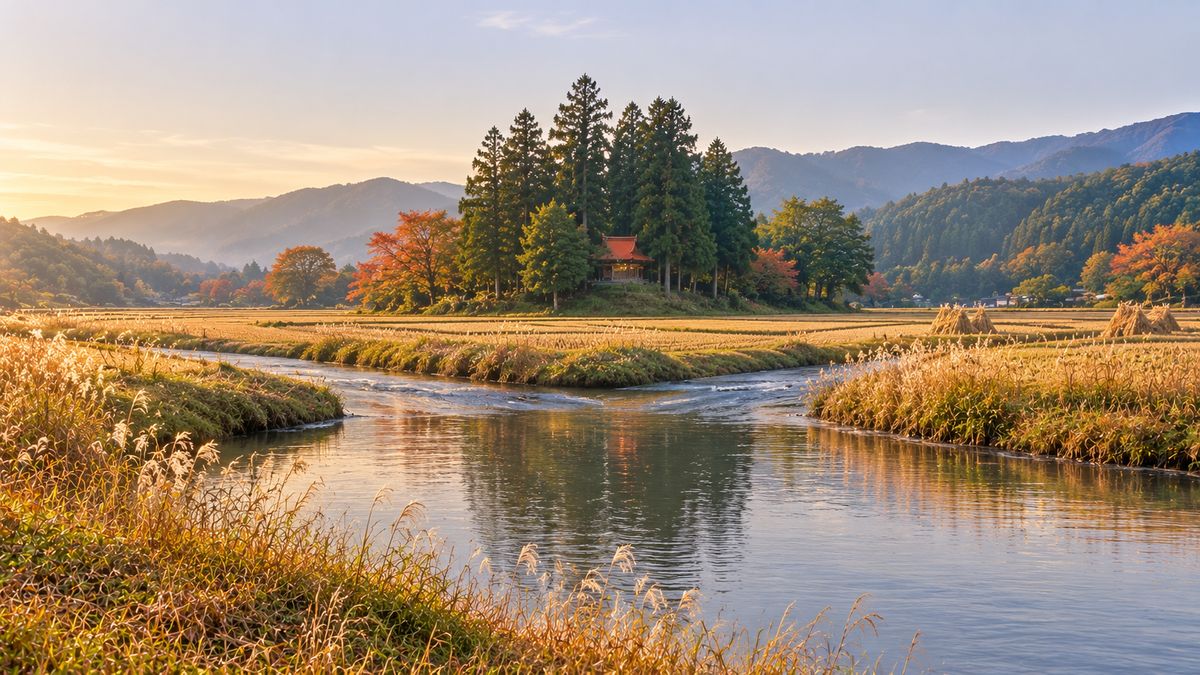
Beside that meeting of the waters stands Hirose Taisha. The deity enshrined here is Wakaukanome, who watches over water and the harvest of the fields. The shrine's beginnings are said to go back to the time of Emperor Sujin, and in the Edo period it is said to have stood on a sandbank in the middle of the Yamato River. Today, its vermilion halls stand quietly near the spot where the Yamato and Soga rivers come together.
In autumn, many rivers flow slowly between fields where the rice has been harvested. Rain that fell on the Kasuga hills, water that has run through the villages of Asuka: once they mingle here, no one can tell any longer where the water came from.
There is not a single person in this world who is unnecessary.
No matter who they are.
The world, and the people in it, are tightly connected by invisible threads.
You often come across people who see their own existence in a negative light, saying, 'Someone like me only ever causes trouble for others.' But that is not so at all.
As long as we are alive, all of us cause some trouble, large or small, for those around us.
That is something we all do to one another.
Every year on February 11, this shrine holds its rice-planting festival, also known as the Sunakake Matsuri, or sand-throwing festival. Performers acting out the planting of rice and worshippers mix together and throw sand at one another. The sand stands for rain, and it is said that the more sand is thrown, the more rain the year brings and the richer the harvest. The joined rivers then pass through a narrow valley in the western mountains and flow out toward Osaka Bay. Today, too, water gathered from every corner of the basin becomes one beside the shrine, and moves slowly west.