Name Three Good Things from Today
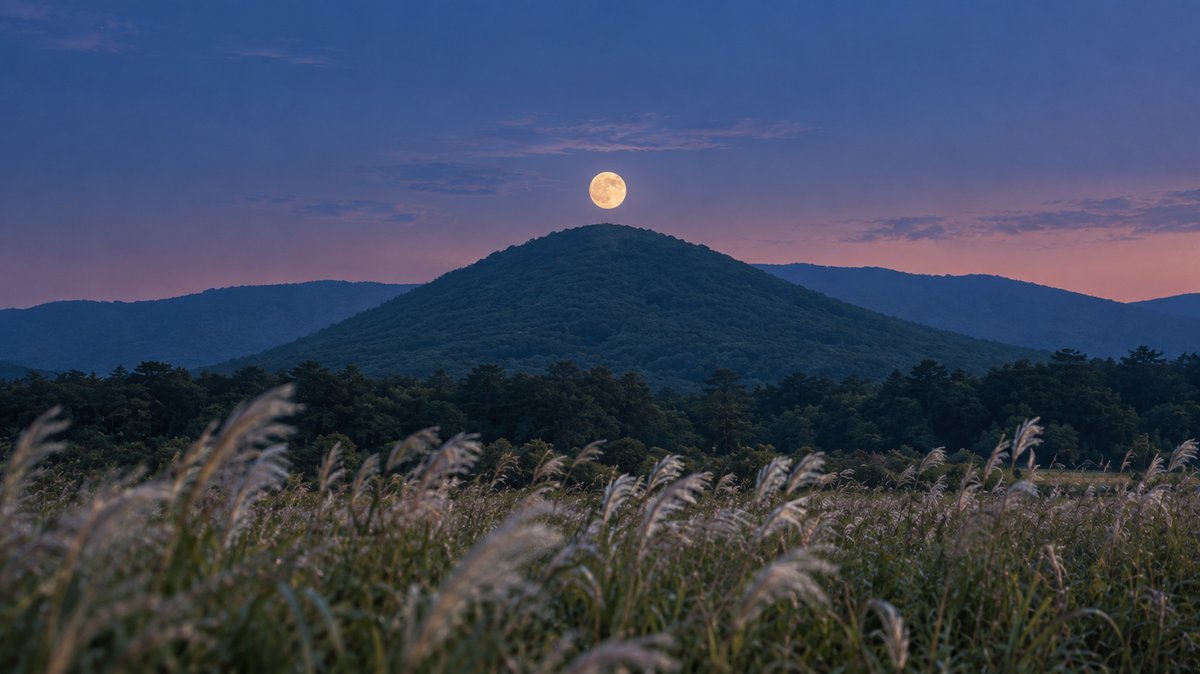
Tomorrow, September 25, is the night of the mid-autumn moon. This year the fifteenth night of the old calendar and the full moon fall on different days, and the moon will not be perfectly round until the small hours of the 27th, two days later. Tonight is the fourteenth day of the eighth month of the old lunar calendar. People long ago called this night matsuyoi, the waiting evening, and gazed at the moon, just short of full, as they waited for the great moon of the next night. At dusk in Nara Park, look to the east: behind Kasuga Taisha, Mount Mikasa, shaped like a parasol laid over the land, draws a quiet outline against the darkening sky.
Some thirteen hundred years ago, a man spoke the name of this mountain in a faraway land. His name was Abe no Nakamaro. In 717, at the age of nineteen, Nakamaro sailed to Tang China as a student with a Japanese embassy. In the second month of that year, before setting out, the envoys paid honor to the gods at the southern foot of this very mountain and prayed for a safe crossing of the sea, according to the Shoku Nihongi, an official chronicle of Japan. In China, Nakamaro took the name Chao Heng, served at the Tang court, rose through its ranks, and became good friends with poets such as Li Bai and Wang Wei.
Thirty-six years later, in 753, Nakamaro was to board a ship bound for Japan, together with the embassy led by Fujiwara no Kiyokawa. At a farewell banquet held in Mingzhou, today's Ningbo, he is said to have looked at the moon and composed this poem: 'Gazing far out across the plain of heaven, I wonder: is that the same moon that rose over Mount Mikasa in Kasuga?' But the ship met a storm and drifted far to the south, to a shore in what is now Vietnam. Word that Nakamaro had sunk beneath the sea reached the Tang capital, and Li Bai mourned him in a poem: 'The bright moon has not come back; it has sunk into the blue sea.'
No matter how often those around you say, 'There are bad times, and there are good times,' or 'Life is not all bad,' there can be times in life when you cannot climb out of the depths of unhappiness.
At such times, it is good to turn your heart toward the 'good,' half by force, and deliberately.
For example, try to name three things from today that were 'good' for you, or that made you 'happy.'
However small they may be, that is fine.
In doing so, there grows within your heart the ability to turn your eyes toward 'the blessings that already exist, though you have simply not noticed them.'
Once that happens, before you know it, you will have climbed out of the depths of unhappiness.
But Nakamaro was alive. From the land where he had drifted ashore, he made his way back to Chang'an and served the Tang court once more. In 770, at the age of seventy-three, he passed away in Chang'an, never having set foot in his homeland again. His poem of longing was later chosen as the seventh poem of the Hyakunin Isshu, and even now it is recited aloud in the card games played at New Year. Tonight, the waiting-evening moon hangs in the eastern sky over Nara. It shines in the same way above those hurrying home and above those who stop to look up. Even if clouds gather tomorrow night, beyond them there will be the same moon that Nakamaro once looked up at.