Pause, and Look Back at the Road
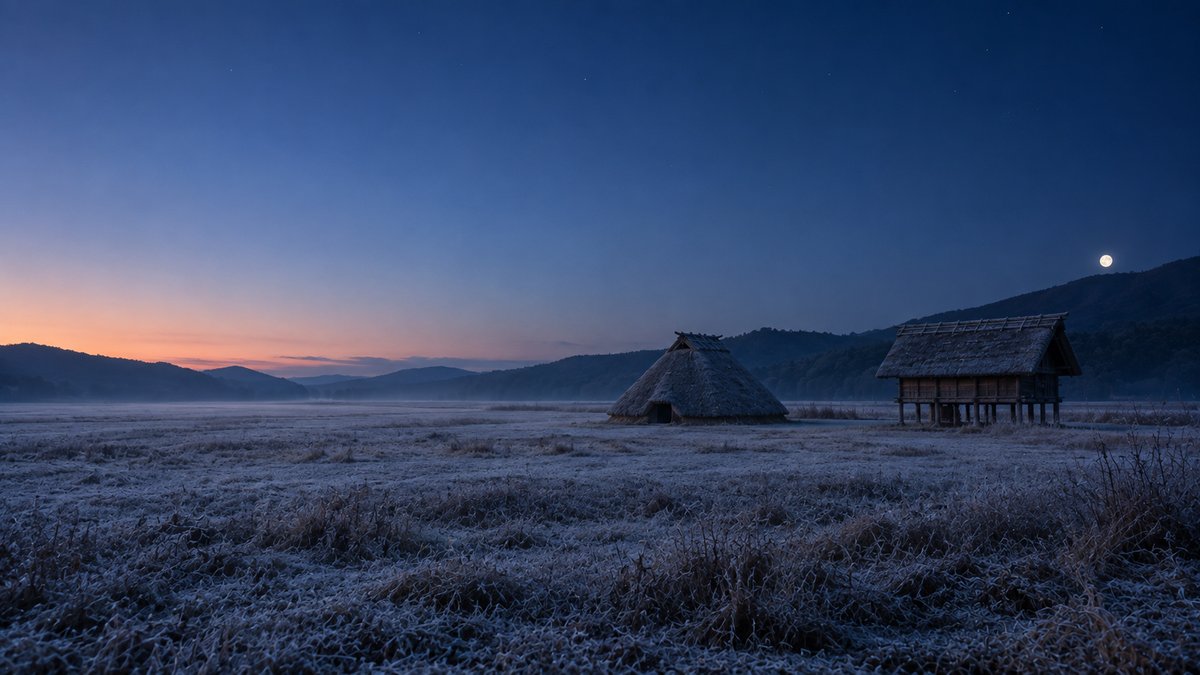
In the hills of Uda, at the south-eastern edge of the Nara basin, lies a field once called Akino. In the days of Asuka it was an imperial hunting ground, and today, on the grass, the traces found in the Nakanosho excavation have been built back up as a low wooden hall and a pit dwelling of the late seventh century. Beside them stands a statue of the court poet Kakinomoto no Hitomaro, seated on his horse, gazing at something far off.
In the winter of 692, Hitomaro rode out with the hunting party of the young Prince Karu. This same field was where the prince's late father, Prince Kusakabe, had once ridden. The party entered the plain during the night, kept watch in a rough shelter, and waited for the morning of the hunt.
Near daybreak, Hitomaro turned to look behind him. In the eastern sky the kagirohi was beginning to show — the faint glow that rises about an hour before sunrise, only on clear, hard-frozen winter mornings — and when he looked back to the west, a pale moon hung low. Light ahead, moon behind. In that narrow space between them, he must have thought of the one who had ridden here before. The poem that came to him has been recited ever since: in the eastern field I see the glow of dawn rising, and turning to look back, the moon is sinking low.
There are moments in life when you must throw yourself into something with everything you have.
But if it is only ever that, both heart and body wear down. And your life, too, comes to lack a certain balance.
Ask yourself: are you running a marathon at the pace of a fifty-metre dash?
Stop from time to time. Put on some music, perhaps, and look back slowly over the road you have come. Let your thoughts travel to that person in your memory, far away now.
Do that, and the balance of heart and body — thrown off by all the busyness — will settle again.
Now the field is a quiet park in Uda. Once a year, on the seventeenth day of the eleventh month of the old lunar calendar, people climb the hill while it is still dark, breathing white into the cold, and wait for the moment the eastern sky turns to gold — to see the same light, in the same place, that was seen thirteen hundred years ago. The statue of Hitomaro still faces the way he had come, and does not move. The hunt ended long ago; the names of the princes are far away now. And still the glow of dawn rises again, and the moon sinks again.