Technique Comes Later
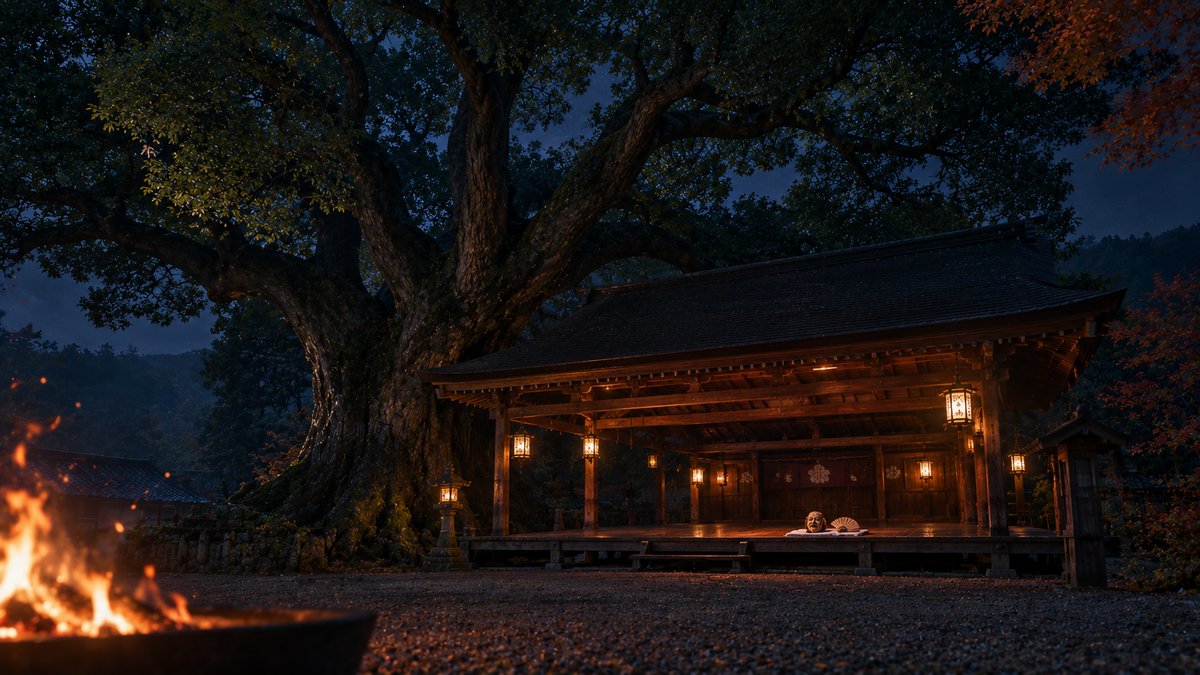
Tucked quietly into the village of Nara-zaka stands Naratsuhiko Shrine. Behind its main hall grows a great camphor tree, its trunk measuring some 7.5 meters around, rising to a height of about 30 meters, said to be nearly a thousand years old — its branches spreading wide as it keeps a silent watch over the shrine.
Every year on the night of October 8th, this ground hosts the offering of "Okina-mai," a sacred dance said to be one of the origins of Noh theater, designated in the year 2000 as an Important Intangible Folk Cultural Property of Japan. It preserves an ancient form found nowhere else: three okina dancers performing side by side. The three-person dance of the tayu and his two attendants, and the exchange between Senzai and Sanbaso performed without ever facing one another — every single movement is a fixed form, handed down unchanged since a distant age. The young shrine parishioners who take on the role of dancer engrave that form into their bodies again and again from childhood, and only then are they finally permitted to stand on the stage.
Mingled with the rustle of camphor leaves, tonight again, footsteps unchanged from those of distant ancestors are quietly traced into the shrine grounds.
Sometimes, technique is necessary too.
But relying on mere technique alone is exhausting in the long run.
First, come to know the universal rules — what might be called the principles of this world — and put them into practice.
Still, learning them is not easy.
Somehow arrive at them, and once you understand the principles of this world, technique will follow on its own.
They say that after repeating the same form again and again, a day comes when, quite suddenly, a movement no one ever taught slips from the dancer's fingertips. It is not something newly invented — perhaps it is proof that a form passed down through hundreds of years has come to overlap with the dancer's own breath. Tonight again, beneath the great camphor tree, the same stillness once known to distant ancestors is quietly handed on to the next generation.