Small "0→1"s, Piled Up Each Day
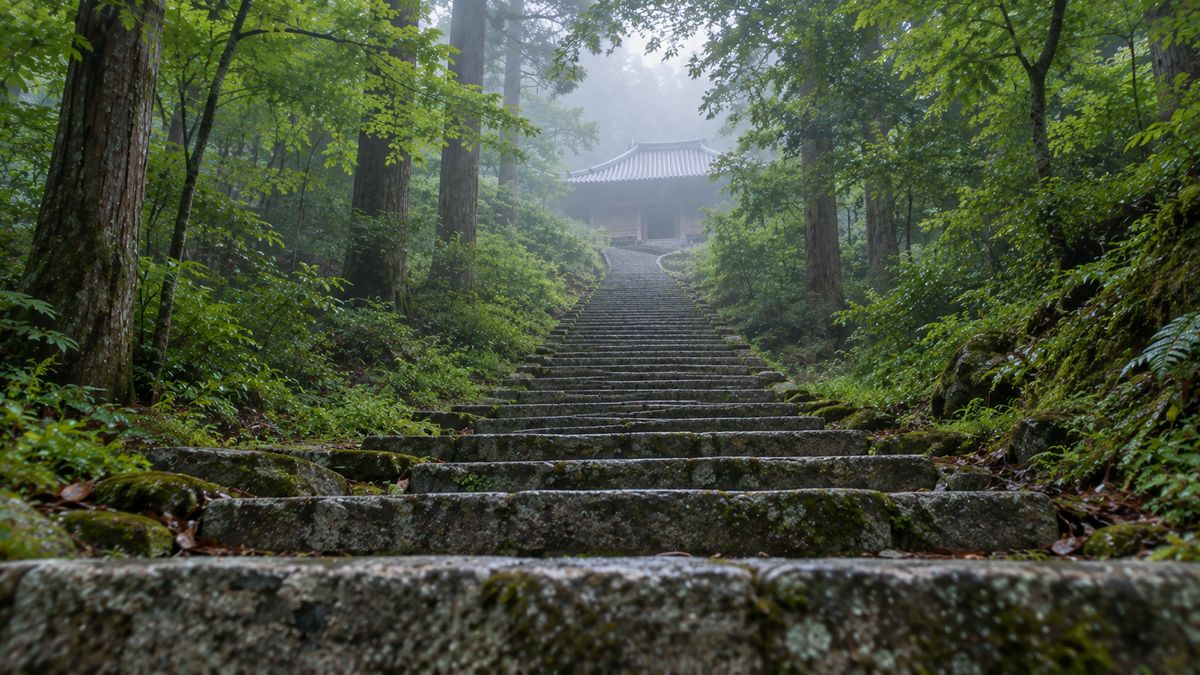
Halfway up Mount Matsuo, past a stone stairway that only lets you climb one step at a time, the main hall of Matsuo-dera stands in quiet. It is said to be the oldest site in Nara Prefecture dedicated to warding off misfortune, and the stone steps allow no shortcuts, only one step after another.
It was Prince Toneri, they say, who built this temple in the second year of Yoro (718 CE). At forty-two, in the middle of his own unlucky year, the prince carried one more prayer alongside his own protection: the completion of the Nihon Shoki, the national chronicle whose compilation had begun by imperial decree of Emperor Tenmu. That work had started thirty-seven years earlier, in the tenth year of Tenmu (681 CE), and the vast undertaking of recording the nation's origins was, even then, still only halfway done.
The main hall, rebuilt more than once over the centuries, stands today in the form given to it in 1337. Few visitors come through the tree-lined grounds, and nothing stirs but the wind and the rustle of leaves. Each stone of the stairway, each pillar of the hall, was set in place by someone, over years no one now remembers.
Achieving a major "0→1" in something big is not easy.
At times, it can even feel as though it's almost impossible to achieve.
But instead of aiming to accomplish something big all at once, let's try piling up small "0→1"s, day by day.
Also, even taking on something new in the smallest way is itself a "0→1", and these, piled up together, lead to the main "0→1" as well.
Two years after Prince Toneri offered his prayer, in the fourth year of Yoro (720 CE), the Nihon Shoki was finally completed. Thirty-nine years had passed since the compilation began. That single chronicle, too, had not appeared in a single day. Even now, beneath the feet of those who climb the stone steps of Mount Matsuo, lie years of quiet work by craftsmen whose names remain unknown. At the far end of small, unseen accumulation, something great still stands there today.