Before Giving Up, Try a Little Last-Ditch Effort
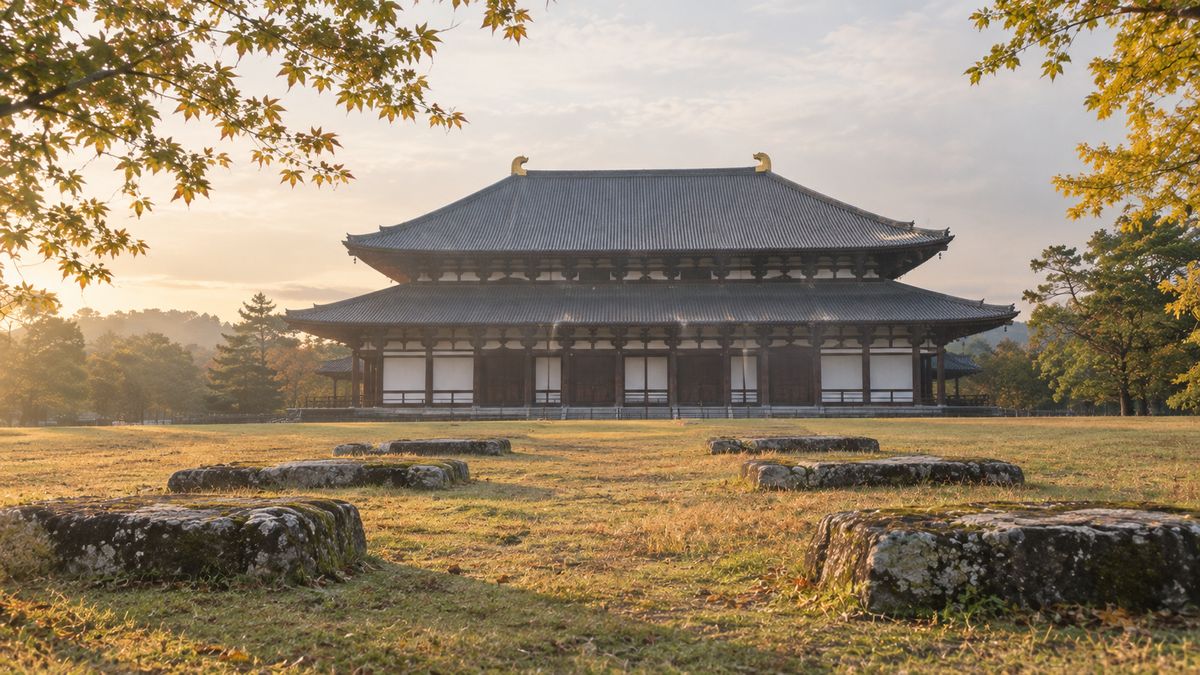
Pass through the Great South Gate and walk on along the approach, and beyond the Middle Gate a vast roof comes into view. This is the Great Buddha Hall of Todai-ji Temple. Crowned with golden ornaments at both ends of its ridge, it is said to be among the largest wooden buildings in the world. The autumn colors of Nara Park are only now moving toward their best.
The hall we see today was built in the Edo period. In 1567, a battle burned the hall to the ground, and for a long time the Great Buddha sat exposed to rain and storms. In 1684, with the permission of the shogunate, a monk named Kokei set out to gather donations from province to province. In 1692, once the repairs to the Buddha were finished and the eye-opening ceremony had been held, Kokei turned to rebuilding the hall.
The new hall, however, did not return to its original size. Its front was narrowed from eleven bays to seven, about two-thirds of the width it had when first built. The pillars were not single giant trees, but smaller timbers gathered together and bound with iron hoops. Even so, the two great beams that hold up the roof each needed one long, single tree. It was in 1702 that word came of two huge red pines on the grounds of Shiratori Shrine, on the slopes of Mount Kirishima in Kyushu.
In life, and in our daily living as well, when you run into a wall or a hard problem, what do you do?
Giving up quickly and moving on to the next thing is surely a fine move too.
But even if you may give up in the end, first try a little last-ditch effort.
Look for whether there might be another way.
Rather than seeking a result one hundred percent the same as your original goal, hold your hopes to seventy or eighty percent and give it a try.
A path may unexpectedly open.
What matters is not insisting on your original hundred percent.
When you face some problem, I hope you will put this into practice.
The two red pines came down the mountain, crossed the sea, traveled up the rivers, and reached Todai-ji in the autumn of 1704. The next year, Kokei died in Edo, without seeing the hall finished. It was completed four years after that, in 1709. Walk around to the north of the hall, and at the site of the lecture hall, which was never rebuilt, the great foundation stones of the Nara period still remain. Back to the south, many people still stop before the Middle Gate today and look up at the vast roof. Not many of them, perhaps, know that this width is only about two-thirds of what it once was.