The Old and the New Are Connected
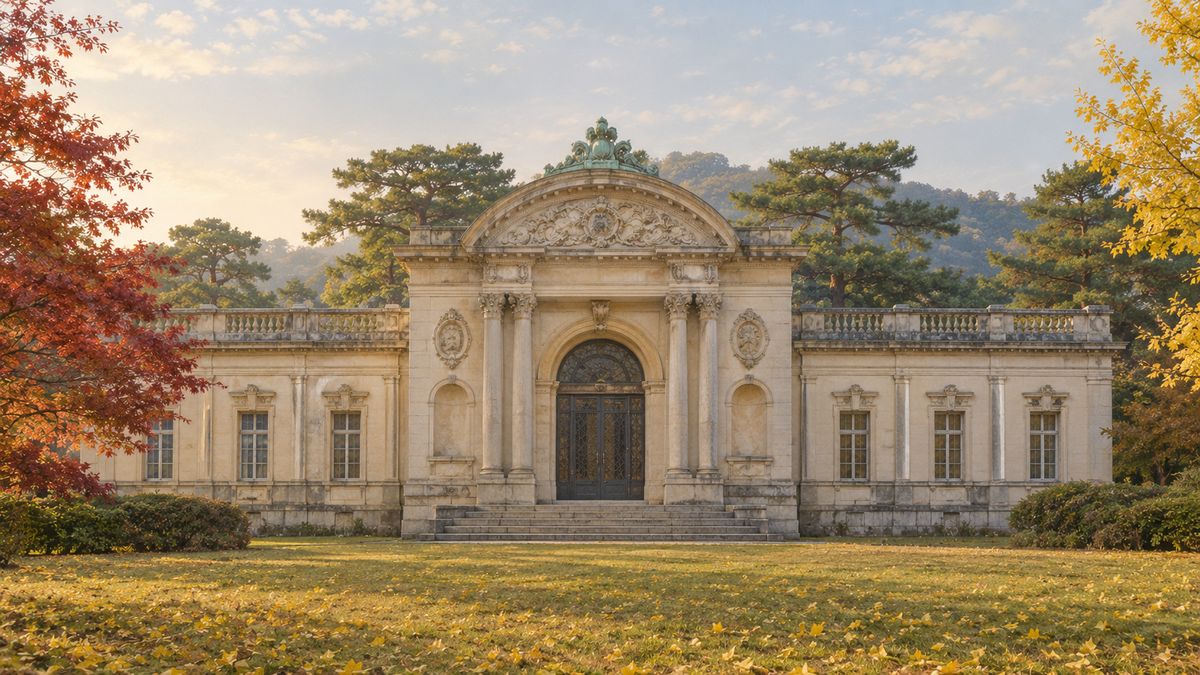
In a corner of Nara Park, at the back of the Nara National Museum grounds, stands a Western-style building with pale cream walls. Completed in 1894, it was the first full-fledged Western building in Nara. It was designed by Katayama Tokuma, the court architect who would later build the Akasaka Palace. Once the main hall of the Imperial Nara Museum, it is now called the Buddhist Sculpture Hall.
Stand before the west door and look up, and you will see the arched pediment filled with fine carving. Below it, thick columns, set side by side in pairs, stand on either side of the arched doorway. The ornament on the roof is a bluish green, and on the grey stone trim, faint traces of more than 130 years of rain and weather remain. The decoration around the doorway is said to represent the Western architecture of the mid-Meiji era, and the building is designated an Important Cultural Property of Japan.
This autumn, its doors are shut. The hall is closed for about a year and a half for renovation work. Even so, a selection of its Buddhist statues can still be seen in the neighboring Bronze Gallery, linked to it by a corridor. Nearby, in the museum's newer halls, the Shosoin Exhibition is being held, and each autumn many people come to see treasures more than twelve hundred years old.
It is about time we changed the idea that 'old things are inferior things.'
We tend, no matter what, to praise new things as good things, and to make light of old things.
Of course, I do not deny that there are bad old customs that have died out, and old things that serve no purpose in a new age.
But to say 'all old things are bad things' is simplistic.
Because the old things that came before exist, the new things of today exist too, and can be new things at all. Old things and new things do not stand against each other; they are connected.
And traditions that have remained since long ago have a reason for having survived through so many ages.
And so it is with people, with buildings, and with things.
The older they grow, the more character they gain.
Here in Nara, such good old things are found in abundance.
A hundred and thirty years ago, in a town of tiled roofs, how new this Western building must have looked. The building that was once a 'new thing' now waits quietly, as repair work goes on, for the day its doors open again. In the evening, when the western sun falls on the carvings above the door, the cream walls take on a faintly warm color. Until that day comes, the hall stays here, slowly adding to its years.