Learning to Do a Little of What We Are Poor At
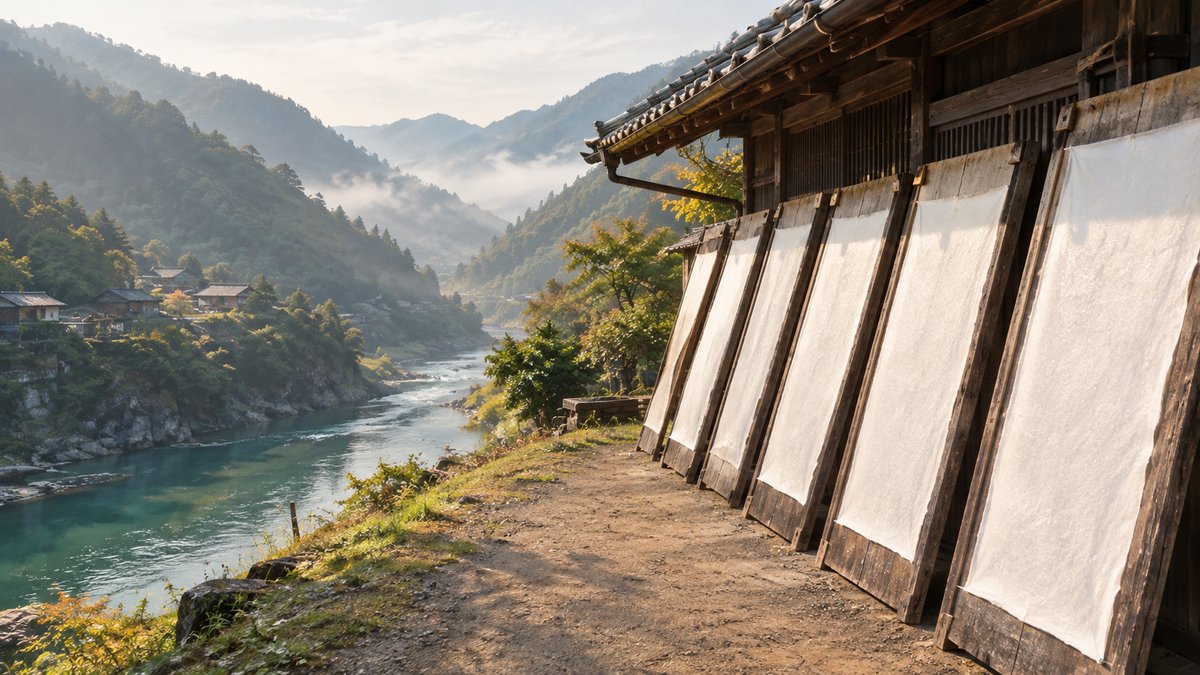
Following the Yoshino River, I made my way into the mountains. The slopes press in on both banks, and homes stand huddled together along them. This area, called Kuzu, is a village where papermaking has flourished since long ago. Even here, the Yoshino River flowing through the valley is still clear.
Papermaking in this village is said to have begun when Prince Oama, later Emperor Tenmu, who was staying in Yoshino around the time of the Jinshin War, taught it to the people of the village. The raw material is paper mulberry. The branches are steamed and stripped of their bark, the bark is rinsed in the clear Yoshino River, then boiled with wood ash. Into this goes white clay dug locally and ground fine, along with neri, a sticky liquid taken from a shrub called noriutsugi, and the paper is then made one sheet at a time. In the Edo period, merchants from Uda sold it far and wide, and so it also came to be known by the name Uda-gami.
Paper is made in the season of cold water. The colder the water, the better the neri works, and the thinner and more even the paper turns out, it is said. From autumn until the end of the following spring, the sound of water in the papermaking vat goes on in the workshops. Each finished sheet is spread out on a board, one by one, and dried in the sun and in the breeze that comes down from the peaks of Yoshino. The paper made this way serves as the outermost backing paper of hanging scrolls and other mounted works. What shows on the front is only the calligraphy or the painting; the paper supports it from behind, for a long, long time. It is said that even museums across the sea rely on it.
Among the purposes of life, it is interesting to add this one: becoming able to do something we are a little poor at.
Naturally, as the saying goes, for rice cakes, go to the rice cake maker; leaving what we are poor at to others, and devoting ourselves to what we are good at, may well be the efficient way.
Of course, that is basically fine.
However, whether to broaden our own knowledge or to understand how the other person feels, the experience of trying, just once, to become a little able to do something we are poor at will hold value in the course of our life.
Around this part of Yoshino, it is said to be a custom that on graduation day, children receive diplomas handwritten by the principal on washi they made with their own hands. For the papermakers, winter is also a season busy with preparing for this. The sheets will hardly come out as thin and even as a craftsman's. Even so, on graduation day, each child's name is written on that one sheet by the principal's brush. Once again this year, the season of dipping hands into cold water comes round to the village of Kuzu.