Glasses Can Be Changed at Any Time
The Yamanobe-no-Michi trail runs gently north and south along the foot of the hills on the eastern edge of the Nara Basin. Roughly halfway along the stretch that passes through Tenri stands Chogaku-ji Temple, an ancient temple said to have been founded by Kukai, known as Kobo Daishi, in 824 at the wish of Emperor Junna. The two-storied gate that first greets visitors has long been called the bell-tower gate, because a bell once hung in its upper storey. That upper storey is thought to date from the Heian period, and it is said to be the oldest bell-tower gate in Japan. Beyond the gate, the temple grounds are wider than one might expect, and quiet in every direction.
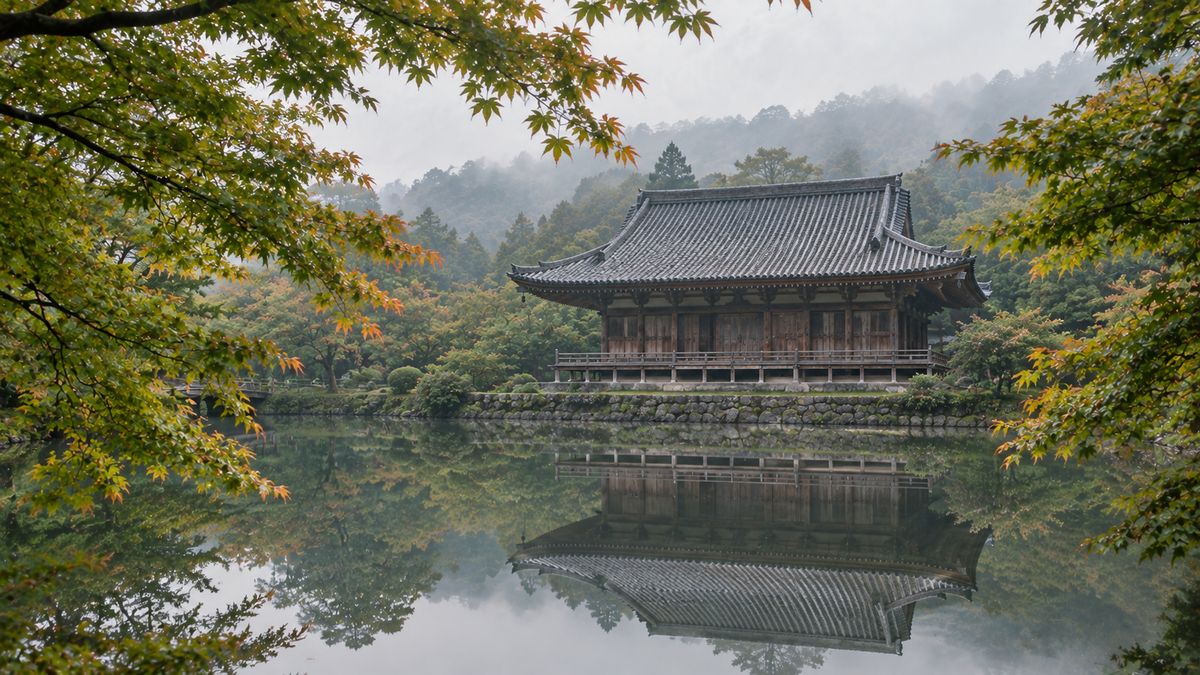
In front of the main hall lies the Hojo-ike pond. The maples around it are still a little early for autumn colors, and nearly all of their leaves remain green. On windless days, the roof of the main hall and the branches of the maples are mirrored sharply on the surface of the water.
Inside the main hall, in the dim light at the front, the Amida triad is enshrined. The statues were made at the end of the Heian period, in 1151, and among Buddhist statues made with the technique called gyokugan, they are said to be the oldest whose date of making is known. The face of the statue is hollowed out from the inside, a piece of crystal polished like a lens is set where the eye should be, and the pupil is painted on its back. Eyes made in this way catch even faint light and seem moist, almost as if alive. Over some eight hundred and seventy years, how many faces have these crystal eyes gazed upon?
Life comes down to this alone: what kind of glasses you look at the world through.
Something you once thought was the worst may turn out to be no great matter after all, you may notice that someone you once could not stand is not so hard to like, or you may catch a glimpse of a gentle side in someone you once thought aggressive, and be surprised.
In short, when you look at life through the glasses of your own heart, how it appears is up to you.
Glasses can be changed at any time.
Now, what kind of glasses will you wear as you go through life?
Sitting down on the wooden veranda of the main hall, I gaze at the pond for a while. On the water, the roof of the hall and the green maples are mirrored upside down. When autumn deepens, these maples turn red, and another autumn of red leaves is said to spread within the pond as well. Passing out through the bell-tower gate, I set off once more along the Yamanobe-no-Michi. In the main hall beyond the gate, those crystal eyes are surely still gazing quietly, in the half-light, at all who come to visit.