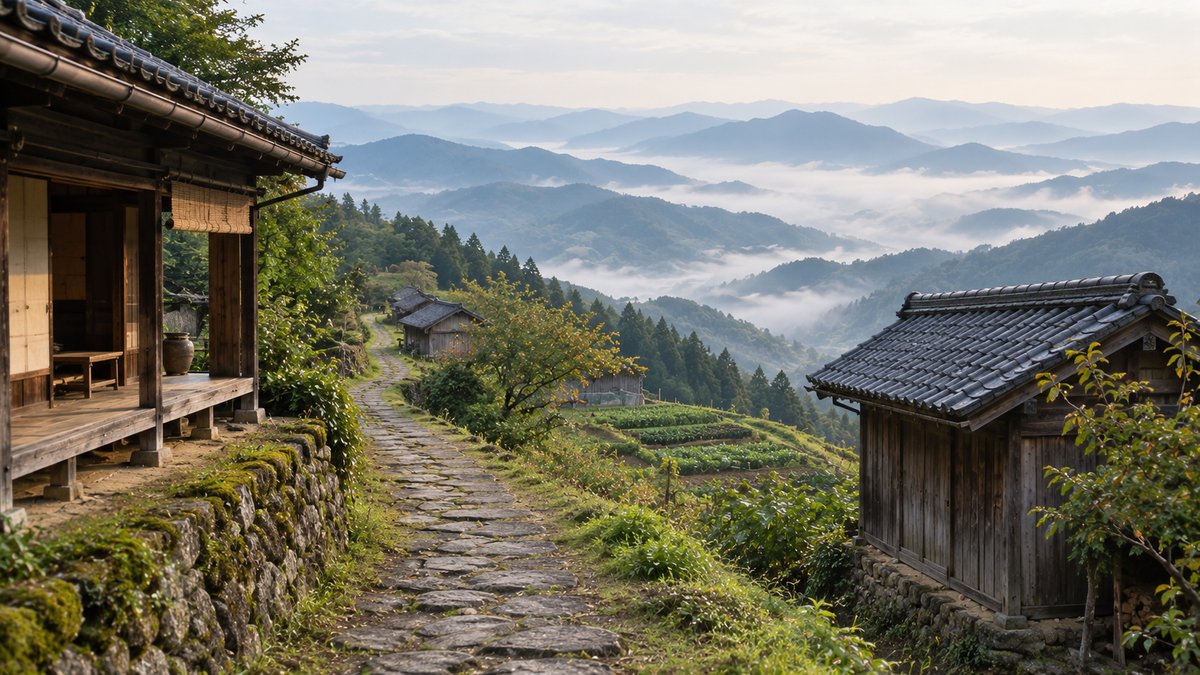
Let Us Set Out in Search of the Meaning of Life's Journey
In the southern part of Totsukawa Village, on a mountain ridge, lies a small hamlet called Hatenashi. From near Totsukawa Onsen, a mountain path of steep stone steps climbs steadily up to it. Above old stone walls, fewer than ten homes stand along the ridge, and to the north the view opens onto layer upon layer of mountains reaching far into the distance. There are several theories about the name Hatenashi, which means 'without end.' One says it comes from the mountains that go on and on without end, an idea said to appear even in writings of the Edo period.
The narrow path running between the homes is the Kohechi, one of the Kumano Kodo pilgrimage routes. It runs about seventy kilometers from Koyasan to Kumano Hongu Taisha, crossing the Kii Mountains from north to south. With three passes higher than a thousand meters, it is known as the most demanding of the routes to Kumano. It began as an everyday path for the people of the mountains and is thought to have existed by the Heian period. In the hamlet, the old path passes right between one family's main home and its annex. Here, daily life and pilgrimage share one and the same path.
The oldest recorded pilgrimage along the Kohechi is said to be that of Doi Kiyoyoshi, a warrior of Iyo Province in the sixteenth century, who walked it to pray for the soul of his father, killed in battle. In the Edo period, merchants from Osaka and people from the distant eastern provinces also came this way. Those from the east set out only after the autumn harvest was in, so by the time they reached these mountains, it was already winter. Even so, it is said, they crossed passes buried under three shaku, nearly a meter, of snow, as if it were nothing at all.
Why do people travel?
Of course, the purpose differs from person to person.
Some enjoy activities that can only be experienced in that place.
Some enjoy eating the local food.
Some enjoy meeting and getting to know the local people.
There must be many ways to enjoy a journey.
At the same time, travel can also be a great help in searching for the meaning of life.
And life itself is also a journey.
So let us set out on a journey, in search of the meaning of the journey called life.
Beyond the hamlet, the path enters the mountains again and climbs to Hatenashi Pass, more than a thousand meters high, where a stone figure of Kannon still remains. Along the old path, stone figures of Kannon, modeled on the thirty-three temples of the Saigoku pilgrimage, are set one after another, from the thirty-third on the Totsukawa side to the first at Yagio, on the Hongu side. They were donated and set in place in 1922 and 1923. Crossing the pass and counting the stone figures one by one on the way down, a walker at last sees, through a gap in the trees, the land around Hongu. In Hatenashi today, a single path still brushes past the eaves of the homes and goes on, over the mountains.