This World Brings About What We Focus On
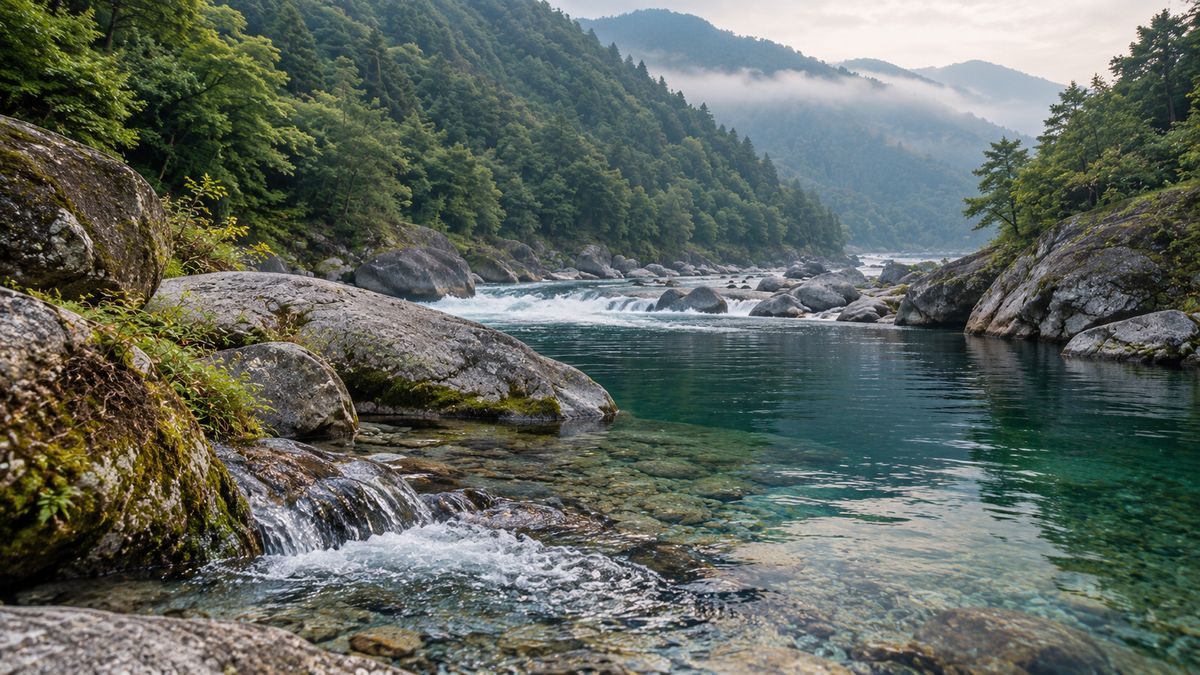
The second day of October. Miyataki, in the town of Yoshino, at the northern foot of Mount Yoshino. Here the Yoshino River bends in a great curve, huge rocks crowd in from both banks, and rapids and deep pools follow one after another. The trees on the mountains are still green; it is a little too early for autumn colors. Sit on a rock by the river, and the only sound is the water running over the rapids.
From the Asuka period into the age of the Nara capital, an imperial villa, the Yoshino Palace, is thought to have stood on these riverbanks. Many sovereigns came here, among them Saimei, Tenmu, Jito, Monmu, Gensho and Shomu, and Empress Jito alone made thirty-one visits. Beneath the Shiba Bridge at Miyataki, a small stream that has flowed down from the Yoshino mountains through the Kisa Valley pours into the Yoshino River. The poets of the Man'yoshu called it the Kisa stream. The deep pool where it enters the river is known as Yume-no-Wada, and many of those poets wrote of it.
At the end of one spring, Otomo no Tabito, a counselor of state who had followed the emperor on a visit to Yoshino, was commanded to compose a poem. In it he wrote: The Kisa stream that I saw long ago, as I see it now, has grown clearer still. He had seen the river once before, and now, after many years, he was seeing it again.
The moment we let our guard down, quickly and without even noticing, we focus on 'what we lack,' and we end up lamenting it.
Of course, a certain sense of lack can sometimes help us chase after something, work hard to gain it, and grow as a result.
But always lamenting 'what we do not have,' insisting that we are unhappy, only draws 'a state of not having' and 'a state of unhappiness' toward us in reality.
This world runs on a law: it brings about whatever a person focuses on.
Later, past the age of sixty, Tabito was sent far away to Dazaifu, in Kyushu. A poem he wrote there remains: If only my life could go on unchanged, so that I might go once more to see the Kisa stream I saw long ago. In that distant land, what Tabito carried in his heart was the flow of that clear little stream. In 730 he returned to the capital as a senior counselor of state, and the following year he passed away at the age of sixty-seven. At Miyataki in October, the Kisa stream still flows quietly into Yume-no-Wada, today as ever.