Settle the Balance Yourself
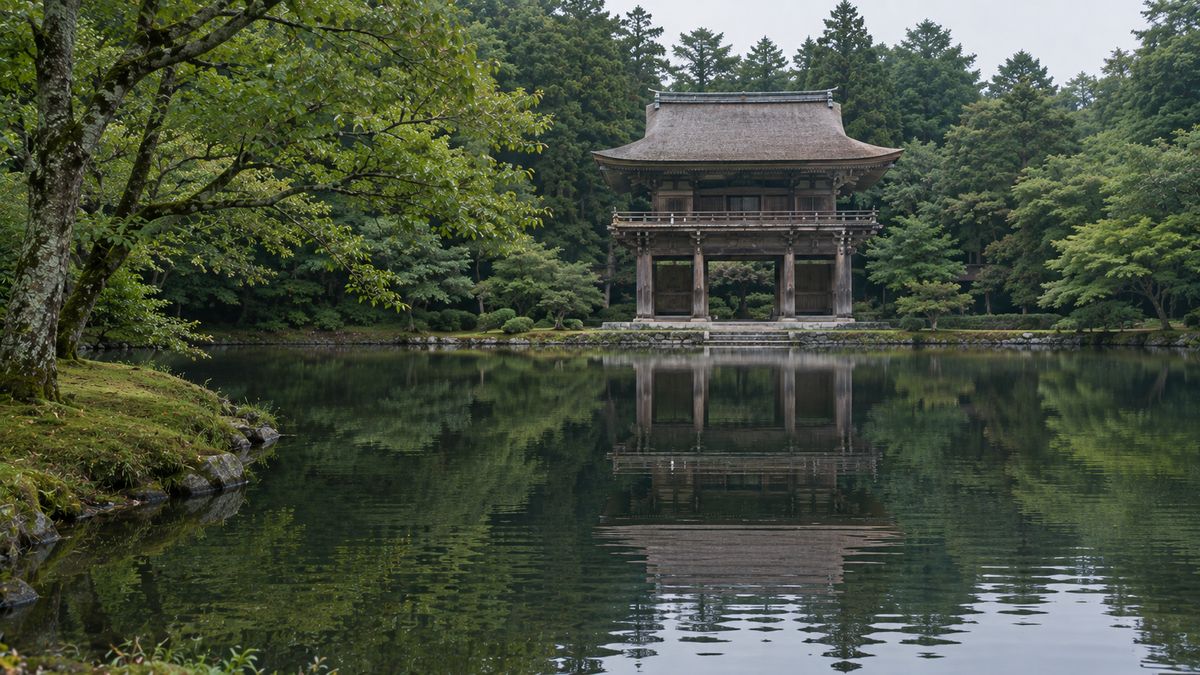
Twelve kilometers east of central Nara, along National Route 369 toward Yagyu, the way comes to a hamlet called Ninnikusen. Enjo-ji stands beside that road. In front of its two-story gate a garden opens around a pond, and on the face of the water the gate and the trees behind it hang upside down. Now, at the end of September, the autumn color is still ahead. It arrives between late October and late November, and the trees are deep green yet.
The garden is thought to have been made at the end of the Heian period, in the time of the priest Kanpen. There is an island at the middle of the pond and another to the west, and a bridge once crossed to the middle island. Together with the garden of Motsu-ji in Iwate, it is counted among the few Pure Land gardens of that age that survive as they were. The two-story gate was rebuilt in 1468, three bays wide with a single doorway, its hipped-and-gabled roof laid with cypress bark. The main hall belongs to much the same years.
From the Meiji era onward, though, a prefectural road ran right beside this garden, and for a long while the view was spoiled. In 1961 that road was shifted elsewhere. Then in 1976 the garden was restored, and the pond regained the form it had held before. Of the eight hundred years and more since it was made, the span this garden spent spoiled comes to about a hundred.
In all things in this world, balance matters.
Watch the state of your own mind and body carefully, and if you feel that something is amiss, it is telling you that some balance has been lost.
Of course, there are times when you throw yourself at something headlong, and times when you must act knowing full well that your balance will be lost.
At such times, if you fret over your balance at every turn, what would have gone well will stop going well.
What matters is to bear in mind that the balance you have lost is to be set right somewhere in the course of your life.
Yes — you settle the account yourself.
Do that, and things will go astonishingly well.
When a breeze crosses the pond, the gate on the water loses its shape at once and scatters into many fine lines. After a while the breeze drops, and the gate ties its shape together again on the surface. However often you watch, the same thing happens. On the bank stands a tree whose leaves are still green. In another month those leaves will turn, and the water will hold a second autumn. Until that day, the tree simply passes through the season it is in.