Good Times and Bad Times
At the western edge of the Nara Basin, Mount Nijo stands with its two peaks side by side. The higher one, to the north, is Odake, the Male Peak, 517 metres tall; the lower one, to the south, is Medake, the Female Peak, at 474 metres. A volcano more than ten million years ago, the mountain is now covered in trees, and its two summits are joined by a gentle saddle known as Uma-no-se, the Horse's Back. From anywhere in the basin, Mount Nijo looks like a single mountain made of two.
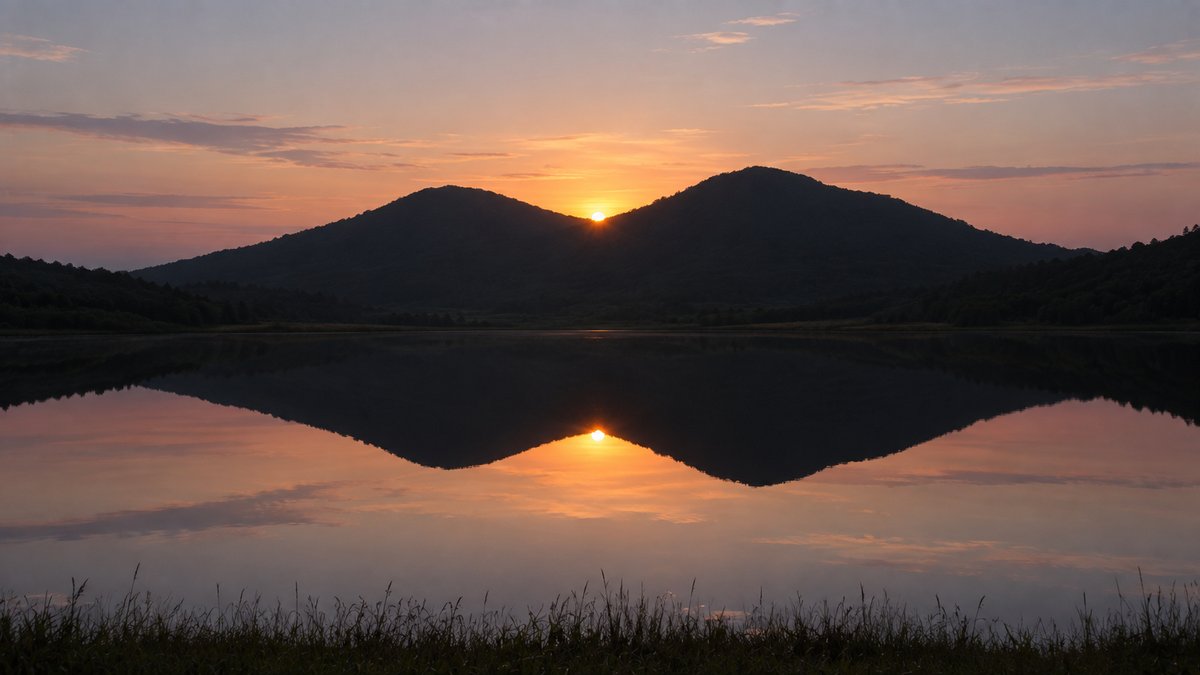
Chimata Pond, in Kashiba, looks straight out west toward Mount Nijo. On clear days, a second Mount Nijo appears upside down on its surface. Around the spring and autumn equinoxes, when day and night grow almost equal in length, the setting sun goes down right between Odake and Medake. As Higan, the week around the equinox, draws near, tripods line the edge of the pond every evening.
As the sun sinks lower, the two peaks darken like shadow puppets, and only the space between them begins to glow. The mountain on the water darkens in the same way, until the two Mount Nijos, one above and one below, hold a single setting sun between them. Before long, the edge of the light touches the ridge, and little by little, it slips away behind the mountain.
In life, there are so-called "good times," and there are also "bad times."
It is not that "good times" are the best, and "bad times" are the worst.
For having good times, and having bad times too, is what life is.
That is something that can never be cut apart.
So, do not get so carried away that you make merry too much in good times, nor sink so low in bad times, as though it were the end of the world.
Once this truly sinks in, you will no longer swing between joy and worry over a simple "good" or "bad."
Once the sun has fully set, the sky stays red for a while, then turns purple, and then deep indigo. Here and there comes the sound of tripods being folded, and people leave the edge of the pond with few words. After this day, the place where the sun sets shifts little by little to the south, until it leaves Mount Nijo behind. From the winter solstice, it begins to come back north, and it is around the spring Higan that it once again sets between the two peaks. Now fully dark, Chimata Pond quietly holds the night sky and the shadows of the two peaks, just as it held the glow of the sunset.