Your Life Is Made Entirely by Your Own Heart
At the foot of Mount Miwa, the town of Miwa in Sakurai City, Nara Prefecture, is known as a home of somen noodles. It is said that more than 1,200 years ago, the son of the chief priest of Omiwa Shrine sowed wheat seeds in this land, well suited to growing wheat, and made noodles from the grain it bore, and that this was the beginning of Miwa somen.
Miwa somen is made only during the cold, dry winter. Oil is brushed onto dough kneaded from wheat flour and salt water, and the dough is drawn out, little by little, thinner and thinner. The work takes two days, and many times along the way the dough is set aside to rest. The craftsmen call this resting umashi. Resting lets just the right amount of moisture escape, it is said, giving noodles that slip smoothly down the throat and do not turn soft easily when boiled.
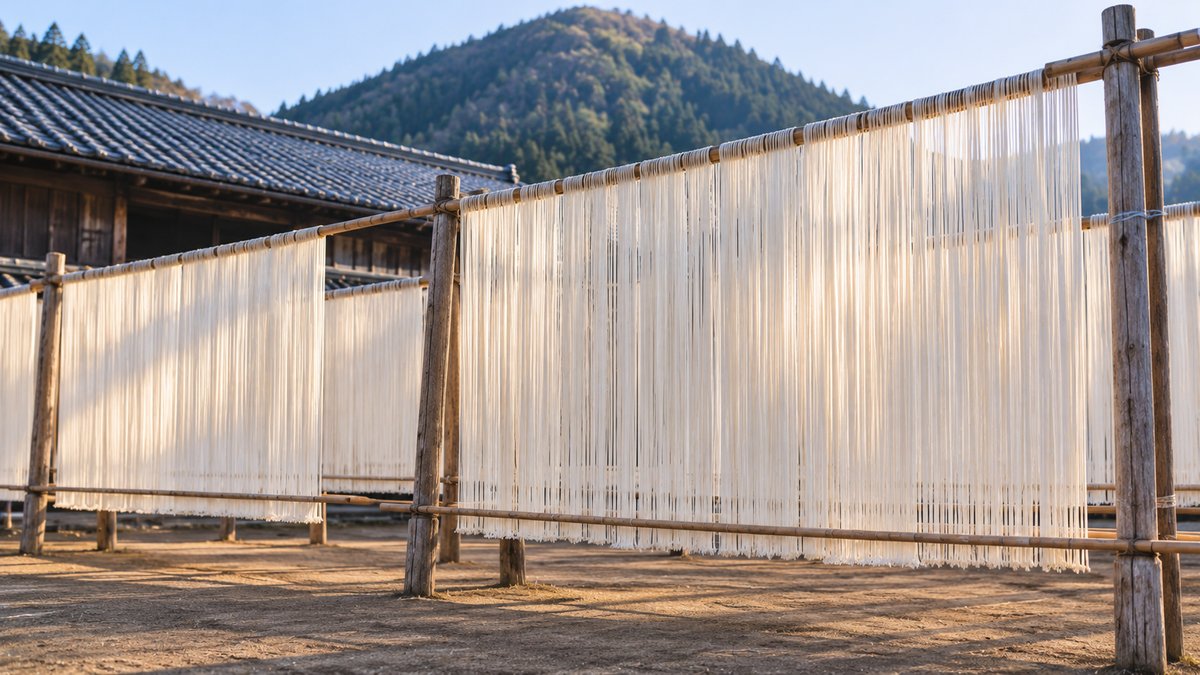
On clear winter days, some noodle makers dry their somen in the sun. White noodles, drawn out to about two meters long, hang side by side from drying racks in the cold, dry breeze. The scene has been registered as one of Nara Prefecture's scenic assets.
Someone who, for some reason, is always irritated.
Someone who, for some reason, is always in a hurry.
Someone who, for some reason, is always angry.
Of course, people have all kinds of circumstances.
But your environment, your life, are all made by your own heart.
It is nothing other than you yourself choosing a life of being always irritated, always in a hurry, and always angry.
Since all the discretion is yours, if you want a life that is fun, joyful and unhurried, all you need to do is act that way every day.
The world may seem bizarrely complicated, but in truth it is quite simple.
An Edo-period book, the Nihon Sankai Meibutsu Zue, described the somen of Miwa as fine as thread and white as snow. On a summer day, when you eat somen that has been boiled and chilled in cold water, each slender strand holds, quietly melted within it, the cold of winter and the slow hours of being rested and drawn out, over and over.