You Are Precious Simply by Existing
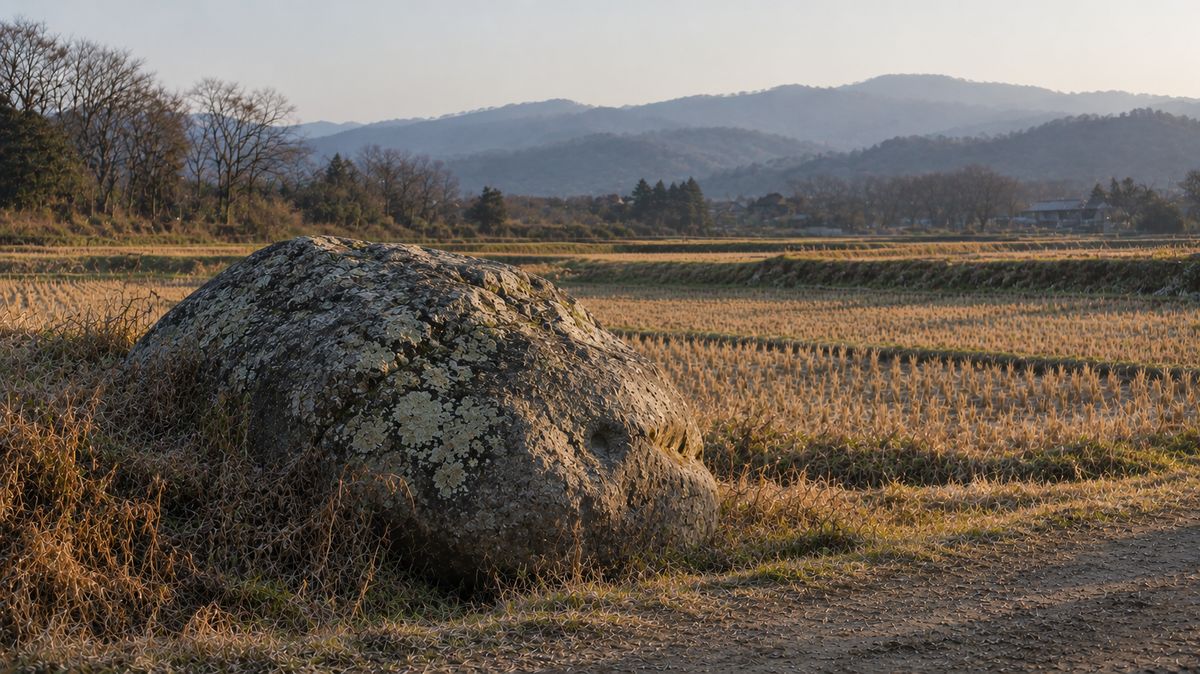
In a place called Kawahara, in the village of Asuka, there is a stone known as Kameishi — the Turtle Stone. It is a block of granite about three and a half metres long, with a large, face-like carving low on its surface. The eyes are hollows; the corners of the mouth turn up a little. It is a face somewhere between a turtle and a frog, with a vacant sort of look, and the stone sits half-buried at the edge of a rice field, facing southwest.
When it was made, by whom, and for what purpose, no one knows. Some say it was a stone that marked the boundary of Kawara-dera, the temple that once stood nearby; others, that it is a trace of a faith in this land older than the coming of Buddhism. But these are only guesses. Nothing certain has been left behind.
The place keeps a story, too. Long ago, when Yamato was still a lake, a quarrel arose between this side, Kawahara, and Taima on the far shore. The water was drawn away to Taima, and every turtle in the lake died. The people of the village, pitying them, carved the shape of a turtle into stone and held a memorial for them. And should the turtle ever turn and glare straight west, toward Taima, the Nara basin will sink once more into a sea of mud — so the telling goes. Lichen fills the fine grooves of the stone. When it rains, water gathers in the hollow of its back, and after a while it dries. People walking the lanes of Asuka come here by a sketch-map, stop before the stone, look for a while at its face, and go on toward the next site.
In life, do we not, without realizing it, come to hold, deep down and unconsciously, the thought: "I have to become someone"?
On the one hand, that thought may hold up an ideal and, through effort upon effort, give rise to growth; on the other, it also brings impatience, and irritation.
"This isn't how it was supposed to be…"
Before that suffering crushes you, cast away the thought — "I have to become someone."
For you are precious simply by existing.
The stone is not doing anything. It works no field and guards no grave, and what it was first shaped for, no one now can say. Even so, the people of the village have always counted this stone as one of their own. As the sun drops low, a soft light falls across that face, the one that is neither turtle nor frog. A child on the way home from school calls out to it in passing — "see you" — and turns off toward the houses.